Biblical Worship Part 2: Biblical Expressions of Worship
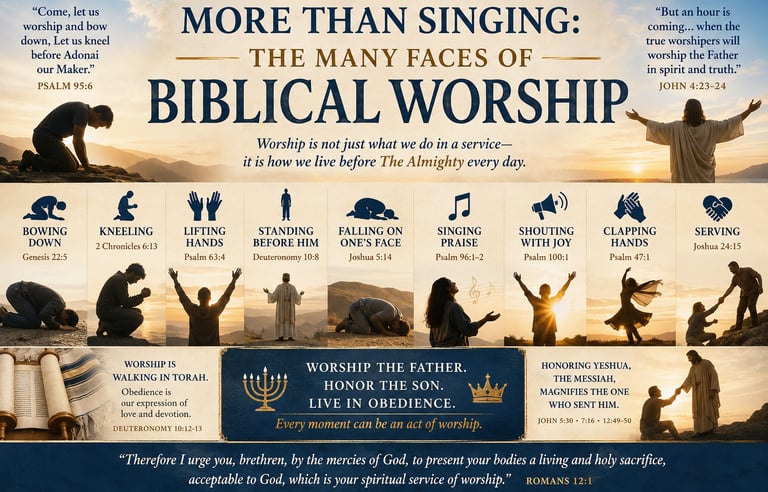
The Scriptures portray worship as much more than music. Throughout the Bible, faithful men and women worshiped The Almighty by bowing, kneeling, lifting their hands, standing in reverence, singing, serving, dancing, praying, and walking in faithful obedience. These biblical examples remind us that worship is the response of our entire being to the greatness and holiness of The Almighty.
Gordon Hayes
7/15/20266 min read
The Many Faces of Biblical Worship: Part 2 - Worship in Action
Having examined the Hebrew and Greek words translated worship, we now turn to the Scriptures themselves. Rather than merely defining worship, the Bible demonstrates what worship looks like in the lives of God's people.
One of the most striking observations is that worship engages the entire person. It involves our minds, our hearts, our voices, our hands, our knees, and ultimately our daily conduct. As James reminds us, faith is demonstrated through action (James 2:17–18). In much the same way, worship is demonstrated through the posture of both our hearts and our lives.
Bowing Before The Almighty
The most common biblical posture of worship is bowing in humility.
Genesis 22:5 (NASB95)
"Abraham said to his young men, 'Stay here with the donkey, and I and the lad will go over there; and we will worship and return to you.'"
Although Abraham does not physically bow in this passage, the Hebrew word שָׁחָה (shāḥâ) indicates humble submission before The Almighty.
Later, the psalmist beautifully combines several postures of worship.
Psalm 95:6 (NASB95)
"Come, let us worship and bow down, Let us kneel before Adonai our Maker."
Notice the progression.
We worship.
We bow.
We kneel.
Worship begins with recognizing the greatness of our Creator and our dependence upon Him.
Kneeling in Reverence
Kneeling expresses humility, repentance, dependence, and prayer.
King Solomon dedicated the Temple in this posture.
2 Chronicles 6:13 (NASB95)
"...he knelt on his knees in the presence of all the assembly of Israel and spread out his hands toward heaven."
Likewise, Ezra prayed:
Ezra 9:5 (NASB95)
"...I fell on my knees and stretched out my hands to Adonai my God."
Neither Solomon nor Ezra knelt because they were commanded to assume a particular posture.
Their bodies simply reflected the humility already present in their hearts.
Falling Upon One's Face
Sometimes reverence became so overwhelming that people fell completely before The Almighty.
When Joshua encountered the Commander of Adonai's army, we read:
Joshua 5:14 (NASB95)
"Joshua fell on his face to the earth, bowed down, and said to him, 'What has my lord to say to his servant?'"
Abram responded similarly.
Genesis 17:3 (NASB95)
"Abram fell on his face, and God talked with him."
Throughout Scripture, falling upon one's face demonstrates complete submission before the holiness and authority of The Almighty.
Standing Before The Almighty
Standing is another biblical posture of worship.
The Levites were chosen:
Deuteronomy 10:8 (NASB95)
"At that time Adonai set apart the tribe of Levi to stand before Adonai to serve Him, and to bless in His name until this day."
Standing signifies readiness.
It expresses honor.
It communicates attentiveness and willingness to serve.
Nehemiah records a similar scene.
Nehemiah 9:5 (NASB95)
"Then the Levites... said,
'Stand up and bless Adonai your God forever and ever!'"
Sometimes worship is expressed not by kneeling but by standing respectfully in the presence of The Almighty.
Lifting the Hands
The lifting of hands appears frequently throughout Scripture.
It symbolizes dependence, surrender, praise, blessing, and earnest prayer.
David writes:
Psalm 63:4 (NASB95)
"So I will bless You as long as I live; I will lift up my hands in Your name."
Again,
Psalm 141:2 (NASB95)
"May my prayer be counted as incense before You; The lifting up of my hands as the evening offering."
The raised hands represent hearts reaching toward heaven.
They acknowledge that our help comes from The Almighty alone.
Singing
Certainly, music occupies an important place in biblical worship.
The Psalms repeatedly encourage God's people to sing.
Psalm 96:1–2 (NASB95)
"Sing to Adonai a new song; Sing to Adonai, all the earth. Sing to Adonai, bless His name; Proclaim good tidings of His salvation from day to day."
Music teaches.
It encourages.
It proclaims.
It celebrates.
Yet Scripture never limits worship to music.
Rather, singing becomes one beautiful expression of an already worshipful heart.
Shouting for Joy
Joy itself becomes an act of worship.
The psalmist declares:
Psalm 100:1 (NASB95)
"Shout joyfully to Adonai, all the earth."
Likewise,
Psalm 47:1 (NASB95)
"O clap your hands, all peoples; Shout to God with the voice of joy."
Such joyful expressions remind us that worship is not merely solemn.
It is also celebration.
Clapping the Hands
Clapping appears as another joyful expression.
Psalm 47:1 (NASB95)
"O clap your hands, all peoples..."
Even creation itself joins the celebration.
Isaiah 55:12 (NASB95)
"...the mountains and the hills will break forth into shouts of joy before you, and all the trees of the field will clap their hands."
Joyful worship honors the One who has redeemed His people.
Dancing Before The Almighty
Dance also appears as an expression of thanksgiving and celebration.
The psalmist writes:
Psalm 149:3 (NASB95)
"Let them praise His name with dancing; Let them sing praises to Him with timbrel and lyre."
Again,
Psalm 150:4 (NASB95)
"Praise Him with timbrel and dancing..."
As with every outward expression of worship, the focus remains upon glorifying The Almighty rather than attracting attention to ourselves.
Worship Through Service
One of the most overlooked biblical truths is that faithful service itself is worship.
Joshua challenged Israel:
Joshua 24:15 (NASB95)
"...choose for yourselves today whom you will serve... but as for me and my house, we will serve Adonai."
Serving one's family.
Helping the poor.
Teaching children.
Encouraging the discouraged.
Preparing meals.
Working honestly.
Keeping one's promises.
Every faithful act offered for the honor of The Almighty becomes an act of worship.
Worship in Spirit and Truth
Yeishua summarized the heart of worship beautifully.
John 4:23–24 (NASB95)
"But an hour is coming, and now is, when the true worshipers will worship the Father in spirit and truth; for such people the Father seeks to be His worshipers.
God is spirit, and those who worship Him must worship in spirit and truth."
Notice carefully that the object of worship is the Father.
Outward expressions have meaning only when they flow from hearts transformed by truth.
Honoring the Messiah
The Scriptures also describe people bowing before Yeishua as the promised Messiah.
The Magi came
Matthew 2:11 (NASB95)
"...they fell to the ground and worshiped Him."
Following the resurrection:
Matthew 28:9 (NASB95)
"...they came up and took hold of His feet and worshiped Him."
These actions should be understood within the biblical principle of agency. Throughout the Scriptures, the representative of a king often received honor because he represented the one who had sent him. Yeishua consistently directed glory to the Father, teaching that he came not to do his own will but the will of the One who sent him (John 5:30; 7:16; 12:49–50). Honoring the Messiah therefore honors the One who appointed him.
Worship Is Walking in Torah
Perhaps the greatest lesson Scripture teaches is this:
Worship is inseparable from obedience.
The prophets repeatedly rebuked Israel because they continued offering sacrifices while neglecting justice, mercy, righteousness, and covenant faithfulness.
Isaiah proclaimed:
Isaiah 1:13 (NASB95)
"Bring your worthless offerings no longer..."
Amos declared:
Amos 5:21–24 (NASB95)
"I hate, I reject your festivals...
But let justice roll down like waters
And righteousness like an ever-flowing stream."
Yeishua echoed the same principle.
Matthew 15:8–9 (NASB95)
"'THIS PEOPLE HONORS ME WITH THEIR LIPS,
BUT THEIR HEART IS FAR AWAY FROM ME.
BUT IN VAIN DO THEY WORSHIP ME,
TEACHING AS DOCTRINES THE PRECEPTS OF MEN.'"
The problem was never music.
The problem was hypocrisy.
One cannot genuinely worship while knowingly rejecting the commandments of The Almighty.
Worship Is a Life Lived Before The Almighty
When we allow the Scriptures to define worship, a beautiful picture emerges.
Worship includes:
bowing before The Almighty
kneeling in humility
standing in reverence
falling on our faces before Him
lifting our hands in prayer and praise
singing songs of thanksgiving
shouting for joy
clapping our hands
dancing in celebration
serving Him faithfully
praying with sincerity
walking in obedience to His Torah
honoring His Messiah as the One whom He has sent
Music is a wonderful expression of worship.
But it is only one expression among many.
Biblical worship encompasses our whole lives.
As Paul reminds us:
Romans 12:1 (NASB95)
"Therefore I urge you, brethren, by the mercies of God, to present your bodies a living and holy sacrifice, acceptable to God, which is your spiritual service of worship."
When our hearts bow before The Almighty, our hands willingly serve Him, and our feet walk in His Torah, every day becomes an act of worship.
This was Abraham's worship.
It was Moses' worship.
It was David's worship.
It was the worship proclaimed by the prophets.
It was the worship lived and taught by Yeishua.
And it remains the worship to which each of us is called today.
May our worship never be limited to the songs we sing.
May it be seen in the lives we live.
For when every aspect of our lives is devoted to honoring The Almighty, worship becomes not merely something we do—but who we are.
Selected References
Brown, F., Driver, S. R., & Briggs, C. A. (1906). A Hebrew and English Lexicon of the Old Testament. Clarendon Press.
Botterweck, G. J., Ringgren, H., & Fabry, H.-J. (Eds.). (1974–2006). Theological Dictionary of the Old Testament. Eerdmans.
Kittel, G., Friedrich, G., & Bromiley, G. W. (Eds.). (1964–1976). Theological Dictionary of the New Testament. Eerdmans.
Vine, W. E. (1996). Vine's Complete Expository Dictionary of Old and New Testament Words. Thomas Nelson.
Contact
Questions or thoughts? Reach out anytime.
Phone
gordon.hayes@torahwithgordon.org
+1 (325) 721-9304
© 2026. All rights reserved.