Considering our Actions and Others in Balance
The Torah says to consider the needs of others and how our actions affect them.
Gordon Hayes
7/11/202616 min read
Considering Others in the Community of Faith
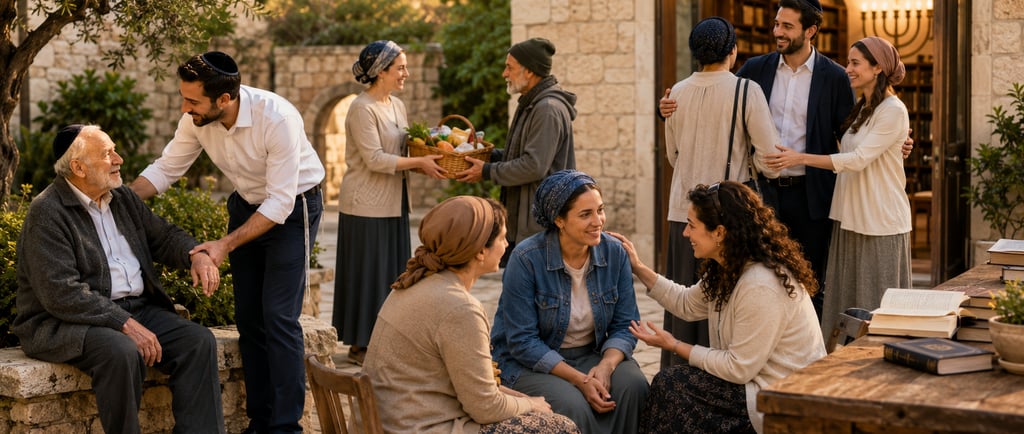
One of the central values woven throughout the Torah is the call to consider the well-being of others. Covenant life was never meant to be purely individualistic. The people of The Almighty were not called merely to believe correct things privately, but to live together as a holy people whose daily choices reflected His character.
This is one reason the Torah speaks so often about how we treat our neighbor, the poor, the stranger, the widow, the orphan, the servant, the laborer, the elderly, and even the vulnerable animal. The Torah is not only concerned with what happens in the sanctuary. It is also concerned with what happens in the marketplace, the field, the home, the courtroom, the dinner table, and the congregation.
Our actions affect those around us.
A harsh word can wound another person. A careless decision can burden the community. A selfish attitude can weaken fellowship. But a kind word can strengthen the weary. A generous action can restore hope. A humble spirit can bring peace where there might have been conflict.
From the beginning, the Torah teaches us that our responsibility extends beyond ourselves.
“You shall love your neighbor as yourself.”
— Leviticus 19:18
This command assumes that we naturally care about our own needs and well-being. We protect ourselves. We feed ourselves. We defend ourselves. We make excuses for ourselves. We seek comfort for ourselves. The commandment challenges us to extend that same serious concern to others.
It does not say, “Love your neighbor when it is convenient.”
It does not say, “Love your neighbor when they agree with you.”
It does not say, “Love your neighbor only when they can benefit you.”
The Torah calls us to love our neighbor because The Almighty is holy, and His people are called to reflect His holiness in the way they treat one another.
Covenant Life Is Communal
Modern Western culture often emphasizes the individual. We hear phrases such as, “Live your truth,” “Do what makes you happy,” or “You don’t owe anyone anything.” While there can be a proper place for personal responsibility and healthy boundaries, this kind of thinking can easily become self-centered.
The Torah gives us a different vision.
In Scripture, the people of The Almighty are not presented as isolated individuals who happen to share similar beliefs. They are a covenant community. They are a people. They are responsible to The Almighty, and they are responsible to one another.
When Israel stood at Sinai, they did not receive the Torah merely as private individuals. They received it as a people entering into covenant. Their obedience or disobedience affected the whole community. Their worship, justice, mercy, purity, and conduct shaped the life of the nation.
This communal emphasis continues throughout Scripture.
The prophets rebuked Israel not only for idolatry, but also for injustice, oppression, dishonest business practices, mistreatment of the poor, and failure to care for the vulnerable. The issue was not merely private belief. It was covenant faithfulness expressed in public life.
A person could not claim to love The Almighty while disregarding the needs of his brother.
That same principle remains important for us today.
A congregation is not simply a place where people attend services. It is a community of faith. It is a place where people pray together, study together, rejoice together, mourn together, serve together, and grow together. This means our words, attitudes, habits, and decisions matter.
A community becomes healthy when its members understand that they are not the center of everything.
Loving Our Neighbor as Ourselves
Leviticus 19 is one of the most important chapters in the Torah for understanding practical holiness. It includes commands about honoring parents, keeping Shabbat, rejecting idolatry, leaving portions of the harvest for the poor and the stranger, refusing theft and falsehood, paying laborers fairly, showing justice in court, avoiding slander, refusing hatred, and loving one’s neighbor.
The command to love our neighbor is not floating in the air as a vague emotion. It is surrounded by practical commandments.
Love is shown by honesty.
Love is shown by fairness.
Love is shown by generosity.
Love is shown by refusing gossip.
Love is shown by correcting someone properly rather than silently hating them.
Love is shown by refusing vengeance.
Love is shown by treating others as people made in the image of The Almighty.
When Yeishua was asked about the greatest commandment, he answered by quoting the Torah. First, he cited the command to love The Almighty with all one’s heart, soul, and strength. Then he cited Leviticus 19:18, the command to love one’s neighbor as oneself.
This matters.
Yeishua did not replace Torah with a new religion of vague love. He drew from the Torah itself and showed that love for The Almighty and love for neighbor are at the heart of covenant faithfulness.
Love is not lawlessness. Love is the proper expression of The Almighty’s instruction.
Considering the Interests of Others
In Philippians 2:4, Paul writes:
“Do not merely look out for your own personal interests, but also for the interests of others.”
This statement fits perfectly within the moral vision of the Torah. Paul was not inventing a new ethic detached from Moses and the Prophets. He was applying the Torah’s concern for others to the life of the believing community.
This does not mean we must ignore our own responsibilities, families, health, or legitimate needs. Scripture does not call us to foolish self-destruction. But it does call us away from a self-centered way of life.
When making decisions, we should learn to ask:
How will this affect others?
Will this strengthen the community or create unnecessary difficulty?
Am I acting out of love, or merely out of convenience?
Am I seeking peace, or am I insisting on my own way?
Am I considering the weak, the new, the wounded, and the easily discouraged?
These questions matter in congregational life.
Something may be technically permissible and still be unwise. Something may benefit us personally while creating hardship for others. Something may allow us to express our opinion while damaging the peace of the community.
Maturity means learning to think beyond ourselves.
The Danger of Self-Centered Faith
A self-centered approach to faith often sounds spiritual, but it produces unhealthy fruit.
It says, “I have a right to say what I think,” without asking whether the words are wise, timely, or edifying.
It says, “The Almighty knows my heart,” while ignoring the harm caused by one’s actions.
It says, “I am just being honest,” when the real issue may be pride, anger, or lack of self-control.
It says, “I do not answer to man,” while refusing proper correction from leaders or the community.
It says, “I only follow Scripture,” while ignoring the many Scriptures that command humility, order, peace, teachability, and love.
A person can quote the Bible and still act selfishly.
A person can defend Torah and still violate the spirit of Torah by mistreating others.
A person can be doctrinally correct on many points and still be spiritually immature.
The Torah calls us to more than correct arguments. It calls us to righteous living before The Almighty and before one another.
Kindness as a Reflection of The Almighty
The Torah consistently portrays The Almighty as compassionate and merciful. He hears the cry of the oppressed. He cares for the poor. He defends the widow and the orphan. He commands justice for the stranger. He remembers the vulnerable.
Because He is compassionate, His people must also be compassionate.
Deuteronomy 15:7 warns Israel not to harden the heart or close the hand against a poor brother. This command is deeply practical. It recognizes that people can see a need and still choose to harden themselves against it.
The Torah does not allow us to spiritualize away human need.
If someone is hungry, compassion may require food.
If someone is grieving, compassion may require presence.
If someone is discouraged, compassion may require encouragement.
If someone is confused, compassion may require patient instruction.
If someone is weak, compassion may require support.
Kindness is not merely a personality trait. It is a covenant responsibility.
A healthy congregation grows stronger when its members actively look for opportunities to encourage and support one another. This kind of community does not happen automatically. It is built through daily choices.
Someone notices who is missing.
Someone checks on the elderly.
Someone encourages the new person.
Someone helps the single parent.
Someone gives quietly.
Someone forgives.
Someone chooses not to repeat harmful information.
Someone stays after services to clean.
Someone prays for the wounded.
Someone listens.
These small acts of faithfulness become the fabric of a healthy community.
The Torah and the Vulnerable
The Torah repeatedly commands Israel to care for those who are most easily overlooked.
The poor were protected through gleaning laws. Farmers were not to harvest every corner of the field or gather every fallen piece of produce. The poor and the stranger were allowed to glean.
This teaches us something important. The Torah does not merely command people to feel compassion. It builds compassion into the structure of community life.
The stranger was to be treated with justice because Israel knew what it meant to be strangers in Egypt.
The widow and orphan were not to be oppressed because The Almighty Himself takes notice of those without ordinary social protection.
Workers were to be paid fairly and promptly.
The elderly were to be honored.
The deaf and blind were not to be mistreated.
These commandments reveal the heart of The Almighty. He cares how the strong treat the weak. He cares how those with resources treat those without resources. He cares how established people treat newcomers. He cares how leaders treat those under their care.
A community that claims to follow Torah must take these things seriously.
Speech That Builds or Destroys
One of the most common ways we fail to consider others is through speech.
Words can heal, and words can harm. Words can bring clarity, and words can create confusion. Words can strengthen trust, and words can destroy relationships.
Leviticus 19:16 says not to go about as a slanderer among the people. This command appears in the same chapter as “love your neighbor as yourself.” That is not accidental.
Slander, gossip, and careless speech are violations of love.
Sometimes people excuse harmful speech by saying, “I am just telling the truth.” But Scripture is concerned not only with whether something is technically true, but also with whether it is righteous to say it, how it is said, why it is said, and to whom it is said.
Not every true statement needs to be repeated.
Not every concern should become public discussion.
Not every frustration should be shared.
Not every private matter belongs in the ears of others.
The book of Proverbs repeatedly warns about reckless speech. A wise person restrains his words. A fool vents everything. A whisperer separates close friends. A gentle answer turns away wrath.
In congregational life, speech is especially important. One person’s careless words can spread discouragement quickly. A rumor can damage trust. A harsh criticism can wound someone who is already struggling. A public complaint can create division where private conversation could have brought peace.
Before speaking, we should ask whether our words are true, necessary, loving, and timely.
Correction Is Also Part of Love
Considering others does not mean avoiding all correction. The Torah does not command sentimental niceness. It commands love, and love sometimes requires correction.
Leviticus 19:17 says not to hate your brother in your heart, but to reprove your neighbor so that you do not bear sin because of him. This is a powerful command.
Silent resentment is not righteousness.
Gossip is not righteousness.
Pretending nothing is wrong while bitterness grows is not righteousness.
The Torah gives us a better way: honest, proper, direct correction.
When someone sins or behaves harmfully, love may require that we speak. But the manner matters. Correction should not be driven by pride, anger, embarrassment, or a desire to win. It should be motivated by restoration and concern for righteousness.
Yeishua also taught a process for dealing with sin between brothers. The goal was not humiliation. The goal was restoration.
A community that never corrects becomes unhealthy.
A community that corrects harshly becomes unsafe.
A Torah-honoring community must learn to correct with humility, truth, patience, and courage.
Bearing Burdens Without Creating Dependency
Paul writes in Galatians 6:2:
“Bear one another’s burdens, and thereby fulfill the law of Messiah.”
This is a beautiful instruction. When someone is crushed beneath a burden, the community should not stand back coldly. We are called to help carry what is too heavy for one person to bear alone.
But only a few verses later, Paul also says that each one will bear his own load.
These two statements are not contradictory. They distinguish between crushing burdens and personal responsibilities.
There are times when people face burdens too heavy to carry alone: grief, illness, sudden loss, financial crisis, trauma, family hardship, or spiritual discouragement. In such times, the community should help.
But there are also ordinary responsibilities each person must carry: honesty, repentance, work, self-control, learning, growth, and accountability.
A wise community helps without enabling irresponsibility.
This distinction is essential.
If we refuse to help people in genuine need, we become hard-hearted.
If we remove every consequence from irresponsible behavior, we may prevent people from maturing.
Compassion must be joined with wisdom.
Kindness Does Not Mean Allowing Exploitation
While Scripture encourages generosity and humility, it also teaches discernment. There is a difference between helping someone in genuine need and allowing oneself, one’s family, or the congregation to be repeatedly manipulated or harmed.
The book of Proverbs frequently warns against foolishness, laziness, deception, anger, and lack of restraint. These warnings are not unloving. They are part of wisdom.
Proverbs 22:3 says the prudent sees danger and hides himself, but the naive continue and suffer for it.
True kindness is not naive.
It seeks the good of others while maintaining healthy boundaries.
Helping someone does not mean enabling patterns that harm them or the community. Sometimes the most loving response includes accountability. Sometimes love says, “We will help you, but we will not lie for you.” Sometimes love says, “We will walk with you, but you must take responsibility.” Sometimes love says, “We forgive you, but trust must be rebuilt.” Sometimes love says, “You may not continue harming others.”
This is especially important in congregational life.
A congregation should be compassionate toward the hurting. But compassion must not become permission for one person to dominate, manipulate, divide, or abuse others.
Leaders must protect the flock. Members must protect the peace of the community. Those who are struggling should be treated with patience, but harmful behavior cannot be ignored indefinitely.
Boundaries are not the opposite of love.
Righteous boundaries help preserve love.
Humility in Community
Humility is one of the most necessary traits for healthy congregational life.
A proud person is difficult to teach. A proud person assumes his perspective is always right. A proud person may listen only long enough to answer. A proud person may confuse strong opinions with conviction from The Almighty.
But humility listens.
Humility learns.
Humility receives correction.
Humility admits when it has been wrong.
Humility does not need to control every conversation.
Humility does not insist on being the center of attention.
Humility does not treat every disagreement as persecution.
Yeishua modeled humility. He served. He taught. He corrected. He suffered unjustly. He did not use his calling as an excuse for selfish ambition.
For those of us who believe Yeishua is the Mashiach, his example should shape how we live in community. Following him does not mean merely affirming doctrines about him. It means walking as his disciples.
A disciple must be teachable.
The Strong and the Weak
Scripture also teaches that those who are stronger in knowledge, maturity, or stability should consider those who are weaker.
This does not mean the weak should control the community. It does not mean immaturity should dictate doctrine. But it does mean that mature people should not use their freedom, knowledge, or strength carelessly.
In Romans 14 and 15, Paul addresses disputes that affected fellowship. His concern was not merely who had the stronger argument, but how brothers treated one another while disagreeing.
The strong were not to despise the weak.
The weak were not to judge the strong.
Both were accountable before The Almighty.
This principle remains important. Some people are new to Torah. Some are coming out of painful religious backgrounds. Some have been wounded by poor leadership. Some are still learning basic biblical categories. Some carry fears and misunderstandings from the past.
Mature believers should be patient with those who are learning.
At the same time, those who are new or weak should remain humble and teachable. Being new does not give someone the right to be divisive. Being wounded does not give someone the right to wound others. Being passionate does not give someone the right to reject order.
Healthy community requires patience from the mature and humility from the immature.
Considering Others in Worship
Considering others also affects how we worship together.
Congregational worship is not merely a personal experience. It is something we do together before The Almighty. That means our actions should promote reverence, order, and unity.
We should ask whether our behavior helps others focus on The Almighty or distracts them. We should consider whether our personal preferences are becoming more important than the needs of the community. We should respect the established order of the congregation, especially when that order is intended to preserve reverence and peace.
This does not mean every tradition is equal to Torah. Traditions must be tested. But neither should every personal preference be treated as a matter of conscience before The Almighty.
There is a difference between obeying Scripture and insisting on our own way.
A humble worshiper can submit to congregational order when that order does not require sin. A mature believer can choose peace over preference. A loving person can say, “This may not be my personal custom, but I will not create disruption over it.”
The synagogue, assembly, or congregation should be a place where people can worship The Almighty without unnecessary confusion or conflict.
Practical Ways to Consider Others
Considering others does not need to remain abstract. It can be practiced in ordinary ways.
We can arrive on time because other people are affected when we are careless.
We can help clean up because service is not beneath us.
We can greet visitors because newcomers often feel uncertain.
We can avoid dominating discussions because others need room to speak.
We can listen carefully before responding.
We can give quietly to those in need.
We can speak well of others when they are absent.
We can bring concerns to the proper people rather than spreading them broadly.
We can respect leaders while still testing all things by Scripture.
We can be patient with children, the elderly, and those who learn differently.
We can ask forgiveness when we have caused harm.
We can refuse to make every issue about ourselves.
These actions may seem small, but they shape the spirit of a community.
A congregation becomes peaceful not merely because it has correct doctrine, but because its members practice righteousness with one another.
When Personal Rights Must Yield to Love
One of the marks of maturity is the willingness to yield personal rights for the sake of love.
This is not popular in a culture obsessed with rights and self-expression. But Scripture repeatedly calls us to consider others.
There are times when we may have the right to do something, but love asks us not to.
There are times when we may have the right to speak, but wisdom asks us to wait.
There are times when we may have the right to defend ourselves, but humility asks us to answer gently.
There are times when we may have the right to leave a task undone, but service asks us to help.
This is not weakness. It is strength under the control of righteousness.
Yeishua taught that greatness in the Kingdom is connected to service. The greatest is not the one who demands the most attention, but the one who serves faithfully.
In a Torah-honoring community, greatness should not be measured by who knows the most, speaks the loudest, or wins the most debates. It should be measured by faithfulness, humility, service, love, and obedience.
Peace Requires Effort
Peace in a community does not happen by accident. It must be pursued.
Psalm 34 says to seek peace and pursue it. That means peace sometimes runs away from us, and we must chase after it. Peace requires effort, humility, restraint, forgiveness, and wisdom.
Some people think peace means avoiding conflict. But biblical peace is deeper than the absence of visible conflict. True peace includes righteousness, order, truth, and restored relationships.
False peace ignores sin.
True peace addresses sin properly.
False peace silences the wounded.
True peace protects the vulnerable.
False peace avoids hard conversations.
True peace speaks with humility and seeks restoration.
A community built on truth without love becomes harsh.
A community built on love without truth becomes unstable.
A community shaped by both truth and love becomes a place of growth.
The Example of The Almighty
The reason we consider others is not merely because it makes community easier. We consider others because this reflects the character of The Almighty.
He is patient.
He is compassionate.
He is just.
He remembers mercy.
He hears the cry of the afflicted.
He provides instruction for the good of His people.
He corrects those He loves.
He does not abandon His covenant.
When we treat others with kindness, justice, patience, and wisdom, we bear witness to His character.
This is why interpersonal behavior is not a small matter. How we treat one another says something about what we believe concerning The Almighty.
If we claim to serve Him but treat people carelessly, we misrepresent Him.
If we claim to love Torah but use knowledge as a weapon, we misunderstand Torah.
If we claim to follow Yeishua but refuse humility, we are not walking as faithful disciples.
The world has seen enough religious communities marked by pride, harshness, manipulation, and division. Our communities should be different.
They should be places where truth is honored, Torah is loved, Yeishua is followed, and people are treated with dignity.
Balancing Compassion and Wisdom
The challenge for believers is maintaining both compassion and discernment.
We are called to care for those in need.
We are called to encourage and uplift others.
We are called to serve one another in humility.
We are called to forgive.
We are called to be patient.
We are also called to exercise wisdom.
We are called to correct sin.
We are called to avoid enabling destructive behavior.
We are called to protect the vulnerable.
We are called to maintain order in the community.
These responsibilities are not enemies. They belong together.
Compassion without wisdom can become enabling.
Wisdom without compassion can become coldness.
The way of Torah requires both.
A community built on both love and wisdom becomes a place where people can grow, heal, and mature.
Living This Out Daily
Before acting or speaking, we might ask ourselves a simple question:
Will this benefit only me, or will it also bless others?
This question will not solve every situation, but it can help reveal the direction of our heart.
We might also ask:
Am I making this easier or harder for others?
Am I seeking to serve or to be served?
Am I speaking in a way that builds up?
Am I protecting the peace of the community?
Am I showing patience to those who are still learning?
Am I allowing someone to continue harmful behavior without accountability?
Am I reflecting the character of The Almighty?
When we learn to consider the needs of those around us, we reflect the heart of the One we serve.
Communities marked by humility, generosity, truth, compassion, and wise boundaries become powerful testimonies of what covenant life is meant to look like.
This does not mean the community will be perfect. No congregation is perfect. People are still growing. People still misunderstand. People still sin. People still need correction and forgiveness.
But a healthy community keeps returning to the path of righteousness.
It keeps choosing humility over pride.
It keeps choosing service over selfishness.
It keeps choosing truth over appearances.
It keeps choosing restoration over resentment.
It keeps choosing wisdom over chaos.
It keeps choosing love over indifference.
Conclusion: A People Who Reflect His Character
The Torah calls us to be holy because The Almighty is holy. That holiness must be seen not only in what we refuse, but also in how we love.
We honor The Almighty when we consider others.
We honor Him when we care for the weak.
We honor Him when we speak with restraint.
We honor Him when we serve without needing recognition.
We honor Him when we correct with humility.
We honor Him when we set wise boundaries.
We honor Him when we refuse to let selfishness rule the community.
Covenant life is not merely about what I believe, what I want, or what I prefer. It is about walking together before The Almighty as a people called by His Name.
May our homes and congregations become places where Torah is not only studied, but lived.
May our communities be marked by humility, mercy, justice, patience, holiness, and love.
And may our lives reflect the character of The Almighty before one another and before the world.
Closing Prayer
Avinu Malkeinu, our Father and our King, teach us to walk in humility and love toward one another. Help us to care deeply about the needs of those around us and to place the well-being of others alongside our own.
Give us hearts that are generous, patient, and compassionate. Teach us to notice those who are hurting, lonely, weak, or in need. Help us to serve without pride and to encourage without seeking attention.
At the same time, grant us wisdom and discernment so that our kindness is guided by truth and understanding. Help us to set righteous boundaries when needed and to avoid enabling what harms individuals, families, or the congregation.
Strengthen our congregation to be a community where people encourage one another, support one another, correct one another with humility, and grow together in righteousness.
May our actions reflect Your character, may our words bring life, and may our community bring honor to Your Name.
Amen.
Contact
Questions or thoughts? Reach out anytime.
Phone
gordon.hayes@torahwithgordon.org
+1 (325) 721-9304
© 2026. All rights reserved.