Nephilim: Giants, Tyrants, or Fallen Men
The mysterious Nephilim of Genesis 6 have inspired stories about fallen angels, human–demon hybrids, enormous giants, altered bloodlines, and even ancient genetic experimentation. Yet the Hebrew text may be describing something far more familiar and more disturbing: violent, powerful men who dominated society, took women as they pleased, and filled the earth with corruption.
HEBREWBAD DOCTRINETORAH STUDY
Gordon Hayes
7/19/202613 min read
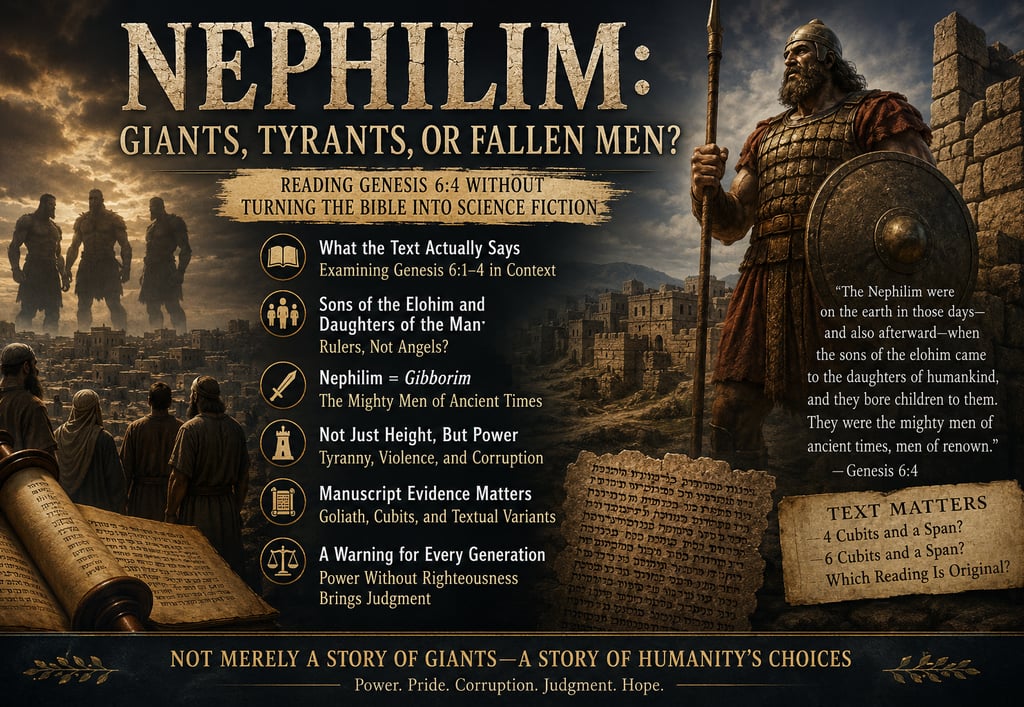
Nephilim: Giants, Tyrants, or Fallen Men?
Reading Genesis 6:4 Without Turning the Bible into Science Fiction
A Mysterious Passage
Few biblical passages have produced more speculation than Genesis 6:1–4.
Entire systems of teaching have been constructed around these four verses. Some describe rebellious angels producing a race of superhuman giants. Others speak of contaminated bloodlines, demonic DNA, ancient genetic manipulation, portals, extraterrestrials, or beings hundreds of feet tall.
Some of these ideas originated in ancient Jewish writings outside the TaNaKh. Others arose from later Christian interpretations. Still others belong largely to modern popular culture.
The angelic interpretation itself is ancient and should not be dismissed as though it were invented recently. Second Temple works such as 1 Enoch and the fragmentary Book of Giants greatly expanded the brief Genesis account into stories about heavenly Watchers, human women, gigantic offspring, forbidden knowledge, and widespread violence. These writings influenced both Jewish and early Christian interpretations, but their expanded narratives should not automatically be read back into Genesis as though Moses included all those details.
Sound interpretation begins by asking:
What does Genesis itself actually say?
Equally important, what does it not say?
What Genesis 6:4 Actually Says
The Hebrew text reads:
הַנְּפִלִים הָיוּ בָאָרֶץ בַּיָּמִים הָהֵם וְגַם אַחֲרֵי־כֵן אֲשֶׁר יָבֹאוּ בְּנֵי הָאֱלֹהִים אֶל־בְּנוֹת הָאָדָם וְיָלְדוּ לָהֶם הֵמָּה הַגִּבֹּרִים אֲשֶׁר מֵעוֹלָם אַנְשֵׁי הַשֵּׁם
Ha-nefilim hayu va’aretz bayamim hahem, vegam acharei-khen, asher yavo’u benei ha-elohim el-benot ha-adam, veyaldu lahem; hemah ha-gibborim asher me’olam, anshei ha-shem.
A fairly literal translation would be:
“The Nephilim were on the earth in those days—and also afterward—when the sons of the elohim came to the daughters of the man, and they bore children to them. They were the mighty men of ancient times, men of renown.”
Notice what the passage does not explicitly tell us.
It does not say that the sons of the elohim were fallen angels.
It does not say angels changed themselves into human males.
It does not mention demonic DNA.
It does not describe the height of the Nephilim.
It does not say their children were half-human monsters.
It does not explain the biological process involved.
In fact, the Hebrew grammar does not state as clearly as many assume that the Nephilim were necessarily the offspring of these unions. It says the Nephilim were present when the sons of the elohim came to the daughters of humankind, and that the resulting figures were gibborim—powerful men or warriors. The relationship among the Nephilim, the sons of the elohim, and the gibborim remains open to interpretation.
What Does Nephilim Mean?
The Hebrew word is:
נְפִלִים
Nephilim
It occurs by name only in Genesis 6:4 and Numbers 13:33.
It is commonly connected with the Hebrew root:
נָפַל
nafal
to fall
However, the exact derivation is uncertain. Even respected Hebrew lexicons acknowledge that proposed etymologies are not conclusive.
Several meanings have therefore been suggested:
fallen ones;
those who have fallen in battle;
those who cause others to fall;
violent attackers;
powerful warriors;
tyrants before whom others fall;
or individuals who had fallen morally from a former position.
Jewish commentators preserved several of these possibilities. Some interpreted the Nephilim as those who had fallen from greatness. Others understood them as those who caused the world or other people to fall. Still others connected the name with fear, power, or exceptional authority rather than physical height alone.
The word itself does not require the meaning “enormous human.”
How Nephilim Became “Giants”
The ancient Greek Septuagint frequently rendered Nephilim with:
γίγαντες
gigantes
This Greek word eventually contributed to the English term giants. As a result, older English translations such as the King James Version rendered Genesis 6:4:
“There were giants in the earth in those days.”
But the Greek Gigantes were not defined solely by extraordinary height. In Greek traditions, they were especially associated with great strength, violence, arrogance, aggression, and rebellion. Early artistic representations sometimes portrayed them as ordinary-sized warriors rather than towering beings.
The Greek translation may therefore have been attempting to communicate that the Nephilim were fearsome, violent, semi-legendary warriors—not necessarily that they were several stories tall.
Translation always involves interpretation. When the Septuagint translators chose gigantes, they supplied their Greek-speaking readers with a culturally familiar image. That choice profoundly influenced later Jewish, Christian, and English ideas about the passage, but it does not prove that physical height was the primary meaning of the Hebrew word.
The Text Calls Them Gibborim
Genesis 6:4 describes these figures as:
הַגִּבֹּרִים
ha-gibborim
the mighty men, warriors, or powerful ones
The singular form is:
גִּבּוֹר
gibbor
This word regularly describes people of strength, courage, military ability, authority, or reputation. It does not ordinarily mean a person of supernatural height.
Nimrod is called a gibbor:
“He began to be a mighty one on the earth.”
— Genesis 10:8
David’s elite warriors are also called gibborim in 2 Samuel 23. No one assumes that David’s mighty men were angel-human hybrids or enormous giants. They were formidable warriors.
Genesis 6:4 also calls the Nephilim:
אַנְשֵׁי הַשֵּׁם
anshei ha-shem
men of the name, or men of renown
They had reputations.
They were famous—or perhaps infamous.
They may have been celebrated heroes from the viewpoint of human society while being violent oppressors in the sight of The Almighty.
Powerful Men in a Violent World
The immediate context strongly emphasizes moral corruption rather than abnormal biology.
The sons of the elohim:
“saw that the daughters of humankind were beautiful, and they took wives for themselves, whomever they chose.”
— Genesis 6:2
The wording suggests men who possessed enough power to take whichever women pleased them. The text does not emphasize mutual covenant faithfulness. It emphasizes seeing, desiring, choosing, and taking.
This pattern resembles the behavior of powerful kings and rulers who treated women as possessions and accumulated wives according to their own desires.
Only a few verses later, Genesis says:
“The earth was corrupt before God, and the earth was filled with violence.”
— Genesis 6:11
The Hebrew word for violence is:
חָמָס
chamas
It includes violence, wrongdoing, cruelty, injustice, and oppression.
This context supports understanding the Nephilim as brutal, powerful individuals who dominated the general population. Their “greatness” may have consisted primarily in military force, political authority, social status, and the fear they inspired—not necessarily in extraordinary height.
The progression of Genesis also supports this reading. Lamech boasts of killing a man and demanding vengeance seventy-sevenfold in Genesis 4. By Genesis 6, powerful men take women as they please, famous warriors dominate society, and the entire earth becomes filled with violence.
The problem leading to the Flood is not unusual genetics.
It is human wickedness.
“Every intent of the thoughts of his heart was only evil continually.”
— Genesis 6:5
Who Were the “Sons of the Elohim”?
The Hebrew phrase is:
בְּנֵי הָאֱלֹהִים
benei ha-elohim
It may be translated:
sons of God;
sons of the gods;
sons of the elohim;
or members of the divine assembly.
The phrase can refer to heavenly beings in passages such as Job 1:6, 2:1, and 38:7. That is one reason the angelic interpretation cannot simply be dismissed.
But it does not follow that the phrase must refer to angels every time it appears.
The word אֱלֹהִים (elohim) can refer, depending upon context, to:
The Almighty;
other gods;
heavenly beings;
representatives of divine authority;
rulers or judges.
Human kings could also be described using divine-sonship language. In Psalm 2:7, the Davidic king is declared to be God’s son. In 2 Samuel 7:14, The Almighty says of David’s royal descendant:
“I will be a father to him and he will be a son to Me.”
The language of divine sonship does not automatically turn the king into an angel or deity. It identifies his status, authority, allegiance, or appointment.
A Jewish Human-Ruler Interpretation
Jewish interpretation has never been unanimous concerning Genesis 6.
Genesis Rabbah preserves the view of Rabbi Shimon bar Yochai that the benei ha-elohim were “the children of judges.” Other Jewish commentators understood them as princes, noblemen, rulers, or socially powerful men. Rashi and several later commentators preserved forms of this human-authority interpretation alongside other Jewish traditions about angels.
Under this reading, the sons of the elohim were rulers who claimed special divine status or acted as representatives of the gods they served.
They may have been:
kings regarded as sons of deities;
nobles exercising supposedly divine authority;
judges who abused their positions;
warriors devoted to other gods;
or members of ruling families who believed ordinary limitations did not apply to them.
This interpretation takes both parts of the phrase seriously.
They were “sons” in the sense of representatives, followers, members, or those characterized by something.
They were associated with elohim—either through claimed divine authority, pagan allegiance, or royal status.
The text does not tell us enough to identify one of these possibilities with certainty. Yet it demonstrates that “sons of the elohim” does not necessarily mean angels who acquired human reproductive bodies.
The “Daughters of the Man”
The contrasting phrase is:
בְּנוֹת הָאָדָם
benot ha-adam
This is normally translated “daughters of men,” but more literally it means:
“daughters of the human”
or
“daughters of humankind”
or more specifically
daughters of Adam
The word הָאָדָם (ha-adam) may refer to the man, Adam, or to humanity collectively, depending upon context.
These women were daughters of Adam in the broadest sense: ordinary human women descended from the first man.
The contrast may therefore be social rather than biological:
“sons of the gods”—powerful rulers claiming divine authority;
“daughters of the man”—women from the ordinary human population.
The rulers saw the women, selected whomever they wanted, and took them.
This would describe exploitation by powerful men rather than interspecies reproduction.
Did the Unions Produce the Nephilim?
Many translations and explanations assume the children born from these unions were the Nephilim.
That is possible.
But the sentence may also say that the Nephilim already existed “in those days,” when the sons of the elohim took the daughters of humankind.
The verse then identifies the resulting social class as:
“the mighty men who were from ancient times, men of renown.”
In other words, Genesis may be describing a society ruled by predatory elites. Powerful families took women as they pleased and produced dynasties of famous warriors, rulers, and oppressors.
The passage is brief because its main purpose is not to explain the biology of the Nephilim. It serves as the final introduction to the corruption and violence that brought the Flood.
What About the Nephilim After the Flood?
Genesis says the Nephilim were on the earth “in those days, and also afterward.”
Some interpret “afterward” as meaning after the Flood. That creates a serious problem for anyone who believes the Flood was universal.
Genesis says that Noah, his wife, his three sons, and their wives entered the ark. If every other human being outside the ark died, then every post-Flood population descended from Noah’s family.
Therefore, any later people called Nephilim, Anakim, Rephaim, Emim, or Zamzummim must—under a universal-Flood understanding—have descended through Noah, Shem, Ham, Japheth, and their wives.
There are several reasonable ways to understand this:
“And also afterward” may refer to a later period before the Flood rather than after it.
Nephilim may be a descriptive designation later applied to another group of powerful or terrifying warriors.
The spies in Numbers 13 may have exaggerated by using a legendary name to frighten Israel.
If the term indicates a human lineage, that lineage must have passed through someone in Noah’s family.
What the universal-Flood model does not permit is an independent race of pre-Flood beings simply surviving outside the ark without the biblical text mentioning them.
Later Jewish legends attempted to explain this problem by claiming that Og survived by clinging to the ark. That is an imaginative midrashic tradition, not a statement found in Genesis.
The Nephilim in Numbers 13
The only other direct biblical occurrence appears in the report of the spies:
“There also we saw the Nephilim—the sons of Anak are part of the Nephilim—and we became like grasshoppers in our own sight.”
— Numbers 13:33
This statement must be read in context.
Numbers 13:32 says the spies brought Israel an:
דִּבַּת הָאָרֶץ
dibbat ha-aretz
bad or slanderous report about the land
Their words were designed to produce fear.
They claimed:
the land devoured its inhabitants;
all the people were extraordinarily large;
they had seen the Nephilim;
and the Israelites looked like grasshoppers by comparison.
The statement about being grasshoppers is obvious rhetorical exaggeration. The spies could not know how they appeared in the eyes of the inhabitants. They were expressing their own fear and then projecting that fear onto their enemies.
This does not mean that the Anakim were short. The Torah describes the Anakim, Emim, and some Rephaim as great, numerous, and tall. It means that Numbers 13:33 comes from frightened men giving a “bad report,” so their identification of the Anakim with the legendary Nephilim should not automatically be treated as a measured scientific observation.
Tall People Are Not Necessarily Supernatural
The TaNaKh describes several individuals or peoples as unusually tall.
Saul stood taller than most Israelites.
The Anakim were remembered as a tall and formidable people.
The Rephaim and Emim were compared with the Anakim.
Og possessed an unusually large bed.
Goliath was a massive, heavily armed warrior.
None of these descriptions requires angelic ancestry.
Exceptionally tall people exist today. A man over seven feet tall would have appeared even more imposing in an ancient population whose average height was considerably lower. Add armor, weapons, military experience, political power, and a terrifying reputation, and such a person could easily be remembered as a “giant.”
The biblical emphasis is often not simply stature, but the fear produced by powerful opponents.
Og’s Bed Is Not His Height
Deuteronomy 3:11 says Og’s iron bed was nine cubits long and four cubits wide.
Using a conventional eighteen-inch cubit, that produces a bed approximately:
13½ feet long;
6 feet wide.
Some understand the object as a bed, while others have proposed a bier, sarcophagus, or monumental royal couch. Whatever its exact function, the verse gives the dimensions of the object—not Og’s body. A large royal bed may imply a large king, but it cannot tell us his precise height.
Later legends turned Og into a creature capable of uprooting mountains. Those stories demonstrate how biblical descriptions can grow through retelling, but they should not be confused with the more restrained language of Torah.
Goliath and the Manuscript Evidence
Goliath is not directly called a Nephilim in the biblical text. Nevertheless, he is frequently included in discussions of biblical giants.
His height provides an important lesson about textual transmission.
The medieval Masoretic Text of 1 Samuel 17:4 reads:
“six cubits and a span.”
However, the Hebrew Dead Sea Scroll 4QSamᵃ, important manuscripts of the Greek Septuagint, and Josephus read:
“four cubits and a span.”
The Israel Antiquities Authority identifies 4QSamᵃ as a Hebrew manuscript of Samuel from the Dead Sea Scrolls. Textual scholars therefore must weigh two ancient readings rather than assume that only one measurement has ever existed.
Using an eighteen-inch cubit and a nine-inch span:
Textual readingApproximate heightFour cubits and a span6 feet 9 inchesSix cubits and a span9 feet 9 inches
Both readings describe a formidable warrior, but they create very different mental pictures.
At six feet nine inches, Goliath would have been remarkably tall in the ancient world but still within known human variation.
At nine feet nine inches, he would have been extraordinarily unusual.
The existence of the textual variation should make us cautious about constructing elaborate doctrines concerning giant bloodlines from a measurement whose earliest witnesses differ.
Not Every Cubit Was Identical
A cubit was based generally upon the length of the forearm, but different standards existed.
A commonly used estimate is approximately eighteen inches or forty-five centimeters. Ezekiel 40:5 also mentions a longer cubit consisting of a standard cubit plus a handbreadth, approximately twenty-one inches or fifty-three centimeters.
If the longer measurement were used, the possible heights would be:
Textual readingStandard cubitLong cubitFour cubits and a span6′9″about 7′10½″Six cubits and a span9′9″about 11′4½″
This does not mean the long cubit should be applied to Goliath. The Samuel text does not specify it. The comparison simply demonstrates why modern claims about biblical heights should state which cubit is being assumed.
“Six cubits” is not automatically an exact modern measurement until we decide how long the cubit was.
Where the Science-Fiction Interpretations Go Wrong
The greatest problem with many modern Nephilim teachings is not that they take the supernatural world seriously.
Scripture certainly recognizes angels, demons, visions, miracles, and heavenly beings.
The problem is that these teachings often fill every silence in Genesis with speculation and then present that speculation as biblical fact.
Genesis does not mention:
DNA manipulation;
genetic laboratories;
extraterrestrial visitors;
portals between dimensions;
angelic technology;
enormous skeletons hidden by governments;
or a surviving demonic bloodline controlling world events.
Such ideas may make entertaining novels or videos, but they should not be presented as the plain teaching of Torah.
The responsibility of a teacher is to distinguish among:
what Scripture says;
what ancient interpreters added;
what later traditions imagined;
and what modern teachers speculate.
Ancient Jewish writings can help us understand how people interpreted Genesis, but even ancient interpretations must be tested against the biblical text.
A More Sobering Interpretation
The human-tyrant interpretation may appear less exciting than a story about supernatural hybrids, but it is far more personally challenging.
Genesis 6 may be describing a world in which:
rulers claimed divine authority;
powerful men took women as they pleased;
violence became normal;
famous warriors were admired;
human life was treated as disposable;
and society celebrated the very people who oppressed it.
That world does not sound like fantasy.
It sounds painfully familiar.
The danger of Genesis 6 is not merely that unusual beings once lived on the earth. It is that human beings used power without righteousness, desire without restraint, and authority without accountability.
The Almighty responded not because humanity had become genetically unusual, but because:
“The earth was filled with violence.”
Conclusion
The Hebrew word Nephilim does not possess a simple, undisputed definition. It may be related to falling, causing others to fall, fallen warriors, violent attackers, or tyrants whose power brought others down.
The traditional translation “giants” arose largely through the Septuagint’s use of gigantes. That translation may communicate strength, violence, arrogance, and legendary reputation as much as extraordinary stature.
The phrase “sons of the elohim” can refer to heavenly beings in some biblical passages, so the angelic interpretation deserves to be acknowledged as an ancient possibility. Yet Jewish tradition also preserves a human interpretation in which these were judges, princes, nobles, or rulers who abused their authority.
Under that reading, the contrast in Genesis 6 is between powerful men claiming divine status or allegiance and the ordinary daughters of Adam. These rulers took women according to their own desires and produced dynasties of mighty, celebrated warriors.
The post-Flood passages do not require the survival of pre-Flood angel-human hybrids. If the Flood was universal, every later population descended through Noah’s family. The fearful report of the spies may have reused the legendary term Nephilim for the formidable Anakim, while other passages simply describe tall and powerful human peoples.
Even the height of Goliath is less certain than many readers realize. The Masoretic Text gives six cubits and a span, while a Hebrew Dead Sea Scroll, important Septuagint witnesses, and Josephus give four cubits and a span.
We should therefore approach the subject with humility.
The Nephilim may remain mysterious, but mystery does not give us permission to turn speculation into doctrine.
The central message of Genesis 6 is clear enough:
Power had become predatory.
Violence filled the earth.
Human desire operated without restraint.
And The Almighty judged a society that had become thoroughly corrupt.
That warning is more relevant—and more frightening—than any tale of giants.
Selected References
Brown, F., Driver, S. R., & Briggs, C. A. (1906). A Hebrew and English lexicon of the Old Testament. Clarendon Press.
Hendel, R. S. (1987). Of demigods and the deluge: Toward an interpretation of Genesis 6:1–4. Journal of Biblical Literature, 106(1), 13–26.
Meade, J. D., & Gurry, P. J. (2022). Scribes and Scripture: The amazing story of how we got the Bible. Crossway.
Sarna, N. M. (1989). Genesis: The traditional Hebrew text with the new JPS translation. Jewish Publication Society.
Shurpin, Y. (n.d.). Nephilim: Fallen angels, giants or men? Chabad.org.
Wenham, G. J. (1987). Genesis 1–15. Word Books.
Contact
Questions or thoughts? Reach out anytime.
Phone
gordon.hayes@torahwithgordon.org
+1 (325) 721-9304
© 2026. All rights reserved.