Peter's Vison in Acts 10: About Food?
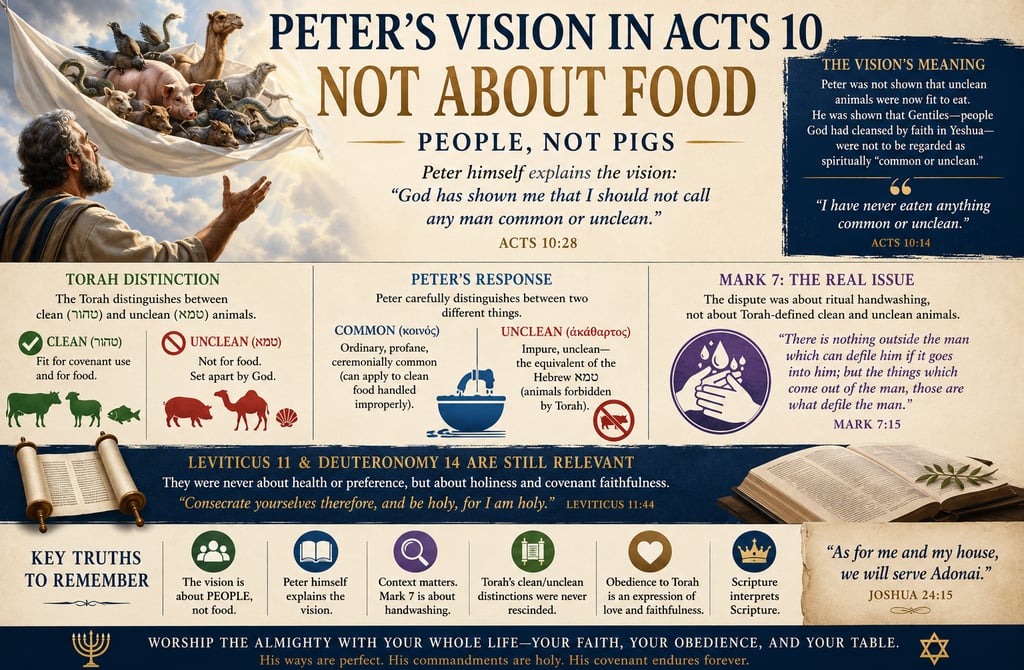
Was Peter's vision intended to abolish the dietary instructions given through Moses? A careful reading of Acts 10 reveals that Peter himself explains the meaning of the vision: it concerned people, not food. When read within its Jewish context and alongside Mark 7, Leviticus 11, and Deuteronomy 14, the biblical distinction between clean and unclean animals remains an important aspect of covenant living.
HERMENEUTICSTORAH STUDYKOSHER
Gordon Hayes
7/15/20267 min read
Peter's Vision in Acts 10: Understanding the Vision in Its Jewish Context
Introduction
One of the most frequently cited passages against Torah observance is Peter's vision in Acts 10.
Many Christians believe this vision abolished the dietary distinctions established in Leviticus 11 and Deuteronomy 14.
Yet a careful reading reveals something surprising.
Peter himself explains the meaning of the vision.
The question is therefore not,
"What do we think the vision means?"
Rather,
"What did Peter say it meant?"
The answer forms the foundation of our study.
Torah's Two Categories
Before examining Acts 10, we should understand the Torah's terminology.
The Torah distinguishes between:
Clean (טָהוֹר)
Suitable for covenant use.
Unclean (טָמֵא)
Unsuitable.
Notice something often overlooked.
The Torah never calls pigs,
camels,
rabbits,
or shellfish
food.
Instead, they are animals that Israel was forbidden to eat.
Leviticus 11 simply excludes them from Israel's menu.
Thus Scripture recognizes two categories:
Animals
and
Food.
Only certain animals qualify as food.
Common versus Unclean
Acts introduces another important distinction.
Peter says:
Acts 10:14 (NASB95)
"By no means, Lord, for I have never eaten anything common or unclean."
Notice the two different Greek words.
κοινός (koinos)
Common.
Ordinary.
Profaned.
Made ceremonially common.
ἀκάθαρτος (akathartos)
Unclean.
Impure.
The equivalent of Hebrew טָמֵא.
Peter distinguishes between them because Judaism distinguished between them.
Something could be ceremonially common without being one of the animals prohibited in Leviticus 11.
For example,
clean meat prepared in an unclean manner,
or handled improperly,
might become "common."
It did not thereby become a pig.
Nor did it cease being one of the animals listed as clean.
Peter's Immediate Response
Peter refuses.
Acts 10:14
"I have never eaten anything common or unclean."
Notice the timing.
This occurs years after Yeishua's resurrection.
If Yeishua had already abolished Leviticus 11,
Peter apparently knew nothing about it.
That fact alone deserves thoughtful consideration.
The Meaning of the Vision
The key to interpretation appears only a few verses later.
Peter says:
Acts 10:28 (NASB95)
"God has shown me that I should not call any man common or unclean."
Notice what Peter does not say.
He does not conclude:
God has shown me that pigs are now food.
Nor,
shellfish are now acceptable.
Nor,
Leviticus 11 has ended.
Peter explains the vision himself.
The animals symbolize people.
Specifically,
Gentiles entering covenant fellowship.
Scripture itself interprets Scripture.
Why Animals?
The symbolism would have been immediately understandable to Jewish hearers.
Throughout the Tanakh,
nations are represented by animals.
Daniel 7.
Ezekiel.
Other prophetic passages.
Peter's vision fits comfortably within that biblical imagery.
What About Mark 7?
Many readers immediately think of another passage.
Mark 7.
Here Yeishua discusses ritual handwashing.
Notice the context.
The dispute is introduced in verses 1–5.
The issue is:
Why do your disciples eat bread with unwashed hands?
Not:
Why do they eat pork?
No one accuses the disciples of violating Leviticus 11.
The controversy concerns a Pharisaic tradition.
Defilement Comes from the Heart
Yeishua explains:
Mark 7:15
"There is nothing outside the man which can defile him if it goes into him..."
His explanation follows.
Moral defilement originates in the heart.
Evil thoughts.
Murders.
Adulteries.
Coveting.
Pride.
These are what truly defile.
The discussion concerns ritual purity,
not dietary law.
"Thus He Declared All Foods Clean"
The NASB95 reads:
"(Thus He declared all foods clean.)"
This statement deserves careful examination.
In Greek,
the phrase may legitimately be understood as Mark's parenthetical explanation rather than words spoken by Yeishua.
Some textual scholars have further suggested that the wording reflects an early editorial gloss that eventually became incorporated into the text, although this remains a minority position and is not demonstrable from the manuscript evidence alone.
Regardless of which explanation one adopts, the context remains unchanged.
The discussion concerns food already recognized as food and the Pharisaic tradition of ritual handwashing.
The issue is not whether pigs become sheep.
The issue is whether ceremonially unwashed hands render otherwise clean food spiritually defiling.
Foods
Notice another important point.
The passage says:
"foods."
The Greek word is:
βρώματα (brōmata).
In both Jewish and Greek usage,
this refers to things regarded as food.
Leviticus had already defined what Israel considered food.
The passage does not redefine the category.
Why Leviticus 11 Still Matters
Leviticus 11 was never merely about health.
Nor merely about symbolism.
It was covenant instruction.
The chapter concludes:
Leviticus 11:44–45
"Consecrate yourselves therefore, and be holy, for I am holy..."
The dietary distinctions form part of Israel's call to holiness.
Peter himself quotes this passage in his first epistle.
1 Peter 1:15–16
"Be holy yourselves also in all your behavior..."
Peter does not present holiness as obsolete.
He presents it as continuing.
Covenant Living
Torah observance has never been about earning salvation.
Israel was redeemed before Sinai.
Likewise,
our obedience does not purchase redemption.
It expresses covenant faithfulness.
Choosing foods The Almighty has declared clean continues that pattern of obedience.
Not to earn His love.
But because we love Him.
Conclusion
Acts 10 does not present Peter abandoning Leviticus 11.
Rather, it presents Peter learning that Gentiles may enter covenant fellowship without first becoming Jews.
Peter himself supplies the interpretation.
The vision concerns people.
Mark 7 does not concern pigs or shellfish.
It concerns ritual handwashing and the true source of spiritual defilement.
The Torah's distinction between clean and unclean animals remains part of Israel's covenant calling to holiness, and the Ketuvim HaNotsrim nowhere explicitly revoke that distinction.
Whether one ultimately agrees with these conclusions or not, one principle should guide every student of Scripture.
Allow inspired authors to explain their own words.
When Peter explains his vision, we should listen to Peter.
When Yeishua explains his teaching, we should follow the context.
When the Torah defines holiness, we should not redefine it.
Only then can we say that we have allowed Scripture to interpret Scripture.
References
Bauer, W., Danker, F. W., Arndt, W. F., & Gingrich, F. W. (2000). A Greek-English Lexicon of the New Testament and Other Early Christian Literature (3rd ed.). University of Chicago Press.
Brown, F., Driver, S. R., & Briggs, C. A. (1906). A Hebrew and English Lexicon of the Old Testament. Clarendon Press.
France, R. T. (2002). The Gospel of Mark. Eerdmans.
Keener, C. S. (2012). Acts: An Exegetical Commentary (Vol. 2). Baker Academic.
Milgrom, J. (1991). Leviticus 1–16. Anchor Yale Bible. Doubleday.
Appendix
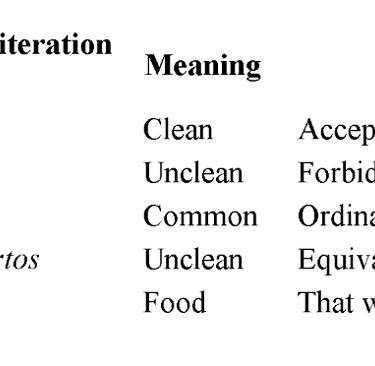
A Word Study of "Clean," "Common," and "Unclean"
One of the reasons Acts 10 is so often misunderstood is that English translations frequently use the word unclean where the Greek text actually distinguishes between two very different concepts. A careful examination of the Hebrew and Greek vocabulary helps clarify Peter's vision and its interpretation.
1. ṭāhôr טָהוֹר
Clean
Basic Meaning
The Hebrew word טָהוֹר (ṭāhôr) means:
clean
pure
ceremonially acceptable
fit for covenant use
Brown, Driver, and Briggs define it as "clean, pure," particularly in ritual and ceremonial contexts (BDB, p. 373).
In Leviticus 11, ṭāhôr describes animals that The Almighty permits Israel to eat.
Example
Leviticus 11:47 (NASB95)
"...to make a distinction between the unclean and the clean, and between the edible creature and the creature which is not to be eaten."
Notice that the Torah itself distinguishes between:
clean animals
unclean animals
The distinction is established by divine command rather than human preference.
2. ṭāmēʾ טָמֵא
Unclean
Basic Meaning
The opposite of ṭāhôr is טָמֵא (ṭāmēʾ)
Meaning:
unclean
impure
ceremonially defiled
This word describes:
certain animals
bodily conditions
corpses
mildew
ritual impurity
Context determines precisely what kind of uncleanness is intended.
Example
Leviticus 11:4 (NASB95)
"Nevertheless, these you shall not eat among those which chew the cud... the camel... it is unclean to you."
Notice something important.
The camel is never called food.
It is called unclean.
Likewise, the pig.
Likewise, shellfish.
The Torah simply excludes them from Israel's diet.
3. κοινός (koinos)
Common
When we arrive at Acts 10, a different word suddenly appears.
Peter says:
Acts 10:14 (NASB95)
"By no means, Lord, for I have never eaten anything common or unclean."
The Greek word translated "common" is:
κοινός
(koinos)
Its basic meanings include:
common
ordinary
profane
ceremonially common
Unlike akathartos ("unclean"), koinos does not ordinarily refer to animals prohibited by the Torah.
Instead, it often describes something that has become ceremonially defiled through contact or improper handling.
This distinction was well known within first-century Judaism.
For example, clean meat could become ceremonially "common" through contact with ritual impurity.
It did not thereby become pork.
Nor did it cease being one of the clean animals identified in Leviticus.
4. ἀκάθαρτος (akathartos)
Unclean
Peter also uses another Greek word.
ἀκάθαρτος
(akathartos)
Meaning:
unclean
impure
This is the standard Septuagint equivalent of Hebrew טָמֵא (ṭāmēʾ)
When Peter says,
"common or unclean," he intentionally distinguishes two separate concepts.
If the words meant exactly the same thing, using both would be unnecessary.
Peter's language reflects the careful distinctions already familiar within Judaism.
Why Peter Uses Both Words
Peter's statement is significant.
Acts 10:14
"I have never eaten anything common or unclean."
If all foods had already been declared clean years earlier, Peter's response would be difficult to explain.
Instead, Peter still distinguishes between:
ceremonially common food
and
biblically unclean animals.
The vision therefore begins with categories Peter already understands.
Its purpose is not to redefine those categories.
5. βρῶμα (brōma)
Food
Another important Greek word appears in Mark 7.
βρῶμα
(brōma)
Meaning:
food
nourishment
that which is eaten
This word does not determine what qualifies as food.
It simply refers to food already recognized as such.
For first-century Jews, Leviticus 11 had long established what belonged in that category.
When Mark discusses food, he is discussing food.
He is not redefining the category.
This observation is often overlooked.
Peter Explains the Vision
Perhaps the most important principle of interpretation appears only fourteen verses later.
Peter himself says:
Acts 10:28 (NASB95)
"God has shown me that I should not call any man common or unclean."
Notice carefully what Peter does not say.
He does not conclude:
pigs are now food;
shellfish are now clean;
Leviticus 11 has been abolished.
Instead, he explains the symbolism.
The animals represented people.
Specifically, Gentiles whom God was now cleansing through faith in Messiah.
The vision therefore addresses fellowship, not dietary law.
Scripture Interprets Scripture
One of the most important principles of biblical interpretation is allowing inspired authors to explain their own visions and teachings.
Peter received the vision.
Peter interpreted the vision.
Luke recorded Peter's interpretation.
Rather than imposing another meaning upon the vision, we should begin with the explanation the Holy Spirit inspired Peter himself to give.
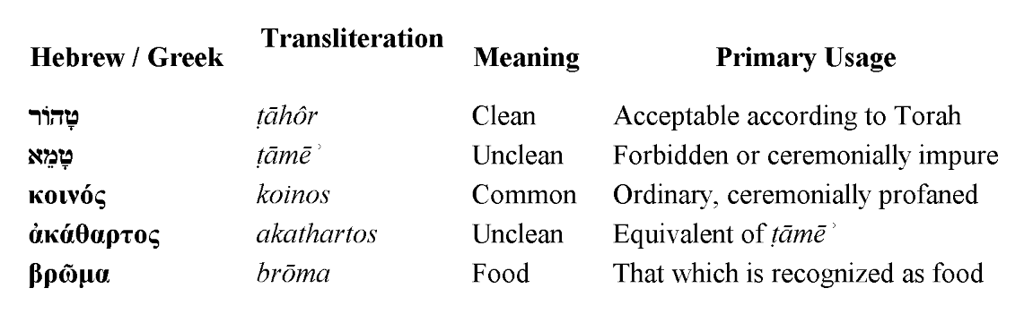
Summary Table
Final Observation
The distinction between common and unclean is one that modern readers often miss because English translations frequently blur the vocabulary. Peter, however, carefully preserved the distinction. His explanation of the vision makes clear that its purpose was not to redefine what the Torah considered food, but to teach that Gentiles who came to faith in the Messiah were not to be regarded as spiritually "common" or "unclean."
When we allow Scripture to interpret Scripture and pay careful attention to the original languages, Acts 10 becomes one of the Bible's clearest demonstrations that context—not isolated proof texts—must govern our interpretation.
Contact
Questions or thoughts? Reach out anytime.
Phone
gordon.hayes@torahwithgordon.org
+1 (325) 721-9304
© 2026. All rights reserved.