Pharmakeia and Modern Pharmaceuticals
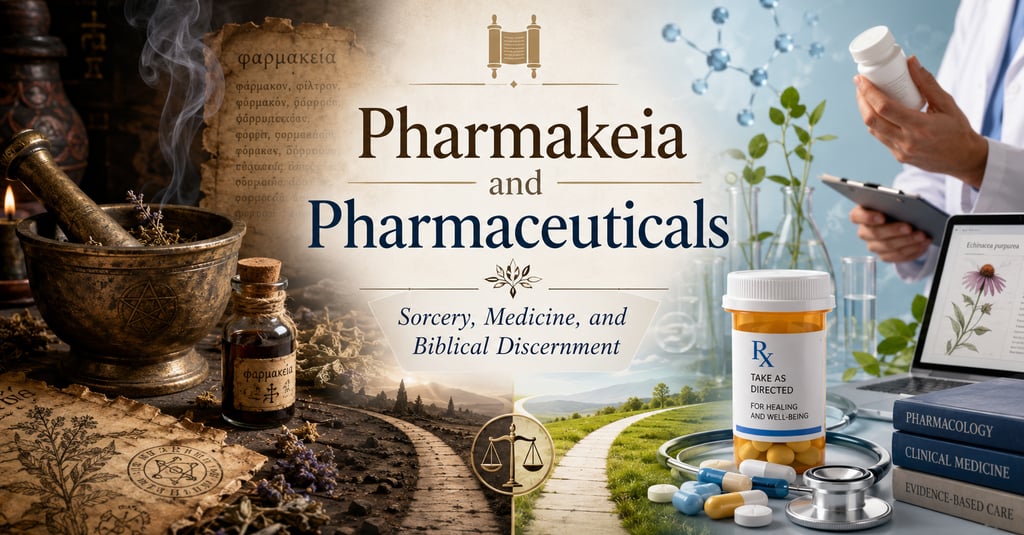
The Greek word pharmakeia is sometimes used to claim that Scripture condemns pharmacies, prescription medications, and modern medical treatment. Yet in its biblical context, pharmakeia refers to sorcery, magical practices, poisoning, and the manipulative use of potions—not to the responsible treatment of illness. Medicine can be misused, but the work of healing and the careful use of medical knowledge can also be received as blessings from The Almighty.
GREEK WORD STUDIESBAD DOCTRINE
Gordon Hayes
7/18/202611 min read
Does the Bible Condemn Modern Medicine?
Understanding Pharmakeia, Sorcery, and the Proper Use of Healing Remedies
A Serious but Misguided Claim
Some believers argue that modern medicine is inherently sinful because the English words pharmacy and pharmaceutical are historically related to the Greek word:
φαρμακεία
pharmakeia
The word appears in passages such as Galatians 5:20, Revelation 9:21, and Revelation 18:23, where it is commonly translated “sorcery” or “witchcraft.”
From this linguistic relationship, some conclude that entering a pharmacy, taking a prescription drug, or receiving modern medical care is participation in biblical sorcery.
That conclusion does not follow.
Words change meaning as languages develop. Two words may share an ancient root without remaining identical in meaning. The English word pharmacy developed through a long history of terms connected with drugs and remedies, but modern pharmacy is not therefore equivalent to magical arts, idolatry, or witchcraft.
The question is not whether pharmakeia could involve substances or potions. It often did.
The real question is:
For what purpose, and in what manner, were those substances being used?
In the passages condemning pharmakeia, the problem is not responsible healing. The problem is the use of potions, poisons, incantations, occult rituals, and deceptive practices to manipulate people, invoke spiritual powers, cause injury, or produce supposed supernatural effects.
The Meaning of Pharmakeia
The Greek noun φαρμακεία (pharmakeia) belongs to a family of words connected with φάρμακον (pharmakon), a term that could refer to a drug, remedy, potion, or poison.
Its meaning depended upon context.
A substance might be used:
as a remedy;
as a poison;
as an ingredient in a potion;
or as part of a magical or idolatrous ritual.
By the time of the Ketuvim haNotsrim, pharmakeia could refer specifically to sorcery or magical arts involving potions and related practices. Lexical summaries therefore include such meanings as the administration of drugs, poisoning, magical arts, enchantment, and sorcery.
Paul lists pharmakeia among the works of the flesh:
Galatians 5:19–21, NASB95
“Now the deeds of the flesh are evident, which are: immorality, impurity, sensuality, idolatry, sorcery… and things like these.”
Notice its placement beside idolatry.
Paul is not giving medical advice. He is describing sinful religious and moral practices associated with rebellion against The Almighty.
Revelation uses the word similarly:
Revelation 9:20–21, NASB95
“The rest of mankind… did not repent of the works of their hands, so as not to worship demons, and the idols of gold and of silver and of brass and of stone and of wood… and they did not repent of their murders nor of their sorceries nor of their immorality nor of their thefts.”
Once again, pharmakeia appears within a context of idolatry, demons, murder, immorality, and theft.
The subject is not legitimate medical care.
Sorcery Involved More Than the Substance
Ancient sorcery could involve herbs, minerals, animal products, intoxicating preparations, poisons, written charms, spoken formulas, amulets, invocations, and ritual actions.
The material substance alone did not define the practice.
An herb might be used to soothe a wound.
The same herb might be mixed into a poisonous preparation.
It might also be administered while invoking a deity, spirit, or magical power.
These were morally different acts even when the same plant was involved.
The difference lay in such matters as:
the purpose of the substance;
the manner in which it was administered;
the spiritual claims made for it;
whether deception or manipulation was involved;
and whether the practice sought power apart from The Almighty.
Biblical sorcery was therefore not simply “the use of medicine.” It was a larger occult practice in which substances might be employed as tools.
Scripture Recognizes Legitimate Remedies
The Bible does not present every physical remedy as evil.
Isaiah instructed that a cake of figs be applied to Hezekiah’s boil:
Isaiah 38:21, NASB95
“Now Isaiah had said, ‘Let them take a cake of figs and apply it to the boil, that he may recover.’”
Jeremiah referred to the medicinal reputation of balm:
Jeremiah 8:22, NASB95
“Is there no balm in Gilead? Is there no physician there?”
In Yeishua’s parable, the Samaritan treated the injured man with oil and wine:
Luke 10:34, NASB95
“And came to him and bandaged up his wounds, pouring oil and wine on them.”
Paul advised Timothy:
1 Timothy 5:23, NASB95
“No longer drink water exclusively, but use a little wine for the sake of your stomach and your frequent ailments.”
These passages do not establish a complete biblical medical system, but they clearly demonstrate that the use of physical substances for healing was not automatically regarded as sorcery.
A particularly relevant statement appears in the Jewish wisdom book of Sirach:
“The Lord created medicines from the earth, and a sensible man will not despise them.”
— Sirach 38:4
Sirach is not part of the Jewish TaNaKh, but it is valuable evidence of ancient Jewish thinking. Its author did not regard physicians and medicines as enemies of faith. He understood healing resources as part of the created world and urged the sick person both to pray and to seek proper care.
Ancient Medicines Were Primarily Natural Remedies
People in the biblical world did not have access to antibiotics, insulin produced through biotechnology, modern anesthetics, MRI machines, responsible, tested vaccines without non-kosher ingredients developed through contemporary immunology, or the thousands of standardized drugs available today.
Their remedies were generally derived from materials available in the natural world:
plants and plant extracts;
oils and resins;
wine and vinegar;
minerals;
animal-derived substances;
poultices;
dietary preparations;
washing and bandaging;
and surgical procedures of varying sophistication.
In this limited sense, ancient medicine more closely resembled herbalism and some forms of modern naturopathic practice than contemporary pharmaceutical medicine.
However, ancient treatments should not be romanticized. Some were beneficial, some were ineffective, and others were dangerous. “Natural” does not automatically mean safe, effective, or approved by The Almighty.
Poison ivy is natural.
Venom is natural.
Toxic mushrooms are natural.
The biblical distinction is not simply between “natural” and “synthetic.” Wisdom asks whether a treatment is safe, effective, ethical, and suited to the patient’s actual condition.
Modern Medical Knowledge Can Be a Blessing
Modern medicine has provided treatments that people in the ancient world could scarcely have imagined.
Physicians can repair damaged joints, replace failing heart valves, treat bacterial infections, stabilize dangerous heart rhythms, control seizures, provide insulin, restore vision, relieve severe pain during surgery, and diagnose internal diseases before they become untreatable.
The existence of medical knowledge does not diminish the power of The Almighty.
Human beings did not create the principles of biology, chemistry, or physiology. They discovered aspects of a world already created and sustained by Him.
Studying the human body can therefore be regarded as studying part of His creation.
Receiving medical care does not necessarily indicate a lack of faith any more than eating food indicates a lack of faith that The Almighty can sustain us without it.
We pray for our daily bread, but we still prepare meals.
We pray for healing, but we may also consult physicians, undergo testing, take appropriate medication, change our diet, rest, exercise, or receive surgery.
Prayer and medicine need not be enemies.
Natural Products and Modern Pharmaceuticals
A substantial portion of modern drug discovery has been influenced by compounds found in plants, microorganisms, marine organisms, and other natural sources. Natural products and their structural relatives have made especially important contributions to treatments for cancer and infectious diseases.
Scientists may identify a biologically active substance within a plant and then:
isolate it;
determine its chemical structure;
test its effects;
measure an appropriate dose;
modify it to improve absorption or stability;
reduce its toxicity;
or manufacture it consistently without harvesting enormous quantities of the original source.
This process is not inherently corrupt or unbiblical.
Isolation can sometimes make a treatment more reliable because the dose is known and contaminants can be controlled. Chemical modification may improve a drug’s usefulness, allow it to reach the proper tissue, or reduce unwanted effects.
At the same time, the process has limitations.
The Question of Synergy
A plant is not normally composed of only one chemical.
It may contain hundreds of compounds, some active and others inactive at ordinary doses. Certain components may strengthen, weaken, balance, or alter the effects of others. Researchers sometimes describe these interactions as additive, antagonistic, or synergistic.
It is therefore possible that an isolated compound will behave differently from the complete plant extract from which it was taken.
Modern research recognizes that complex botanical mixtures may possess pharmacological properties arising from multiple interacting substances. Yet those mixtures are also more difficult to standardize, study, and dose consistently.
This subject requires balance.
It is too simplistic to claim:
“The whole plant is always better.”
It is equally simplistic to claim:
“The isolated compound is always superior.”
Sometimes a whole extract may offer useful complementary effects. In other cases, isolation removes toxic or unpredictable components and allows safer dosing.
The appropriate conclusion depends upon evidence, not ideology.
Does Isolation Cause Side Effects?
All biologically active substances can produce unwanted effects.
That includes:
prescription drugs;
over-the-counter medications;
concentrated vitamins;
herbal extracts;
essential oils;
and naturally occurring substances.
An isolated compound may produce noticeable adverse effects because it is administered at a concentrated and standardized dose. It may affect more than one biological pathway, interact with other medications, or place stress upon the liver, kidneys, heart, or nervous system.
But whole plants can also cause serious adverse effects. Their strength may vary by species, soil, climate, harvesting method, storage, and preparation. They may contain contaminants or interact dangerously with prescription drugs.
Natural-product and drug interactions are a recognized field of medical research because botanical products can alter drug metabolism and produce harmful effects.
The biblical approach should therefore be neither blind faith in pharmaceutical products nor uncritical confidence in natural remedies.
It should be wisdom.
Patents and the Pharmaceutical Industry
Another concern involves pharmaceutical patents.
It is sometimes claimed that drug companies “must change” natural substances because natural remedies cannot be patented.
That statement contains an element of truth but needs qualification.
A naturally occurring substance, merely because someone discovered it in nature, is not automatically eligible for patent protection. Patent law generally requires an invention to be new, useful, and non-obvious, and judicial decisions have limited claims covering products of nature merely as they exist naturally.
Companies may nevertheless seek patents for:
a new synthetic derivative;
a novel formulation;
a previously unknown therapeutic use;
a delivery system;
a manufacturing process;
a combination of substances;
or a composition that is markedly different from what occurs naturally.
This can create an economic incentive to develop proprietary versions of naturally inspired compounds. Patents provide a period in which a company can attempt to recover research, testing, regulatory, manufacturing, and marketing costs without immediate generic competition.
That system can encourage expensive research.
It can also be abused.
When profit becomes more important than patients, companies may pursue products with the greatest financial return, engage in excessive marketing, extend monopolies through questionable patent strategies, or price important medicines beyond the reach of those who need them.
The moral problem is not that the treatment is “sorcery.”
The moral problem is greed, injustice, deception, exploitation, or the neglect of human suffering.
Scripture condemns dishonest gain without requiring us to condemn every physician, pharmacist, researcher, or medication.
Why Medicines Cost So Much
The price of a drug may reflect many factors:
scientific research;
failed experimental compounds;
clinical trials;
regulatory compliance;
specialized manufacturing;
quality control;
distribution;
liability;
marketing;
patent protection;
negotiations with insurers and governments;
and the company’s desired profit.
Shareholder expectations can influence corporate decisions, but they do not provide the only explanation for drug prices.
We should criticize unjust pricing where it exists without turning a complicated medical and economic system into a claim that every pharmaceutical company is practicing witchcraft.
Biblical ethics requires accurate accusations.
“A false balance is an abomination to Adonai, but a just weight is His delight.”
— Proverbs 11:1, NASB95
A just evaluation should acknowledge both the enormous benefits produced by medical research and the genuine ethical failures that sometimes occur within the industry.
Medicine Can Become an Idol
Although modern medicine is not pharmakeia, it can still be misused.
A person may trust physicians while ignoring The Almighty.
A company may value profit more than life.
A practitioner may prescribe irresponsibly.
A patient may abuse pain medication, stimulants, tranquilizers, or other substances.
A society may seek a pill for every difficulty while neglecting nutrition, exercise, rest, relationships, repentance, or necessary changes in behavior.
None of these problems makes medicine itself sorcery.
They demonstrate that every good thing can be corrupted.
Food can become gluttony.
Wine can become drunkenness.
Authority can become oppression.
Wealth can become greed.
Medicine can become exploitation, dependency, or idolatrous trust.
The proper response is not to reject every medical treatment. It is to place medicine within its proper limits under the authority of The Almighty.
Natural Remedies Also Require Discernment
Natural remedies should be evaluated with the same care.
Herbs may contain powerful compounds.
They may alter blood pressure, blood sugar, heart rhythm, blood clotting, liver enzymes, or the effectiveness of prescription drugs.
A natural product should not be combined with medication merely because someone online claims it is safe.
Responsible use includes:
identifying the correct substance;
evaluating reliable evidence;
using an appropriate dose;
considering existing medical conditions;
checking for drug interactions;
and consulting a qualified healthcare professional.
Naturopathic physicians, herbalists, pharmacists, and medical doctors may each possess useful areas of knowledge, but titles and traditions do not guarantee that every recommendation is correct.
Every claim should be examined carefully.
Faith, Prayer, and Treatment
Illness can make people vulnerable to fear, exaggeration, and false promises.
Some teachers tell the sick that taking medication demonstrates weak faith.
Others promise miraculous cures through expensive supplements, secret formulas, or unproven therapies.
Both approaches may cause harm.
Scripture encourages prayer:
James 5:14–15, NASB95
“Is anyone among you sick? Then he must call for the elders of the congregation and they are to pray over him, anointing him with oil in the name of Adonai.”
But prayer does not forbid appropriate treatment.
The same James who encouraged prayer used oil—something that could carry both symbolic and practical significance.
Our confidence rests in The Almighty, not in a pill, herb, physician, or procedure. Yet He may work through the skills of those who study His creation and care for the sick.
What Pharmakeia Actually Condemns
When the passages are read in context, biblical pharmakeia condemns practices such as:
magical potions and enchantments;
occult manipulation;
invoking spirits or false deities;
poisoning;
deception through supposed supernatural powers;
and the use of substances within idolatrous or destructive rituals.
It does not provide a blanket condemnation of:
physicians;
pharmacists;
surgery;
antibiotics;
heart medication;
insulin;
anesthesia;
seizure treatment;
pain management;
or responsibly used natural remedies.
Calling all modern medication pharmakeia confuses etymology with meaning and ignores the moral and religious contexts in which the biblical word appears.
A Torah-Based Approach to Health
A Torah-based approach to health should value:
the sanctity of life;
responsible stewardship of the body;
honest evidence;
compassion for the suffering;
fair access to treatment;
ethical medical practice;
and trust in The Almighty.
It should reject both superstition and arrogance.
We should not assume that everything natural is safe.
We should not assume that everything approved by a regulatory agency is perfect.
We should not treat physicians as infallible.
We should not treat internet personalities as prophets.
We should pray, study, ask questions, seek qualified advice, and make decisions with wisdom.
Conclusion
The Greek word pharmakeia is related historically to words from which English eventually received pharmacy and pharmaceutical. That relationship, however, does not mean that the biblical writers condemned modern medicine.
In Scripture, pharmakeia refers to sorcery, magical arts, poisoning, and occult practices in which potions or substances might be used to manipulate, deceive, harm, or invoke forbidden spiritual powers.
The sin was not the existence of a plant, mineral, or preparation.
The sin was the corrupt purpose and occult manner in which it was used.
The natural world contains substances with genuine healing potential, and many modern medicines have been developed through the careful study of those substances. Medical knowledge can relieve suffering, preserve life, and serve as a blessing to patients.
Modern pharmaceutical systems nevertheless deserve ethical scrutiny. Patent incentives, corporate profit, marketing practices, pricing, and the isolation or modification of natural compounds can create both benefits and problems. But those issues should be evaluated as questions of science, justice, stewardship, greed, and patient welfare—not mislabeled as biblical sorcery.
Likewise, natural remedies should not be treated as automatically safe or spiritually superior. They also require evidence, proper dosing, and careful consideration of harmful interactions.
Our trust belongs to The Almighty.
Our responsibility is to use wisely the resources, knowledge, and healing possibilities found within His creation.
Medicine should never become our god.
Neither should fear prevent us from receiving legitimate help.
The proper biblical response is not superstition, but discernment; not blind trust, but wisdom; and not the rejection of healing, but gratitude for every ethical means through which suffering may be relieved and life preserved.
“The naïve believes everything, but the sensible man considers his steps.”
— Proverbs 14:15, NASB95
This article addresses biblical interpretation and general ethical principles. Decisions concerning medications, supplements, or medical treatment should be made with qualified healthcare professionals who understand the patient’s individual condition and current treatments.
Contact
Questions or thoughts? Reach out anytime.
Phone
gordon.hayes@torahwithgordon.org
+1 (325) 721-9304
© 2026. All rights reserved.