Salvation in the Scriptures
Biblical salvation is far more than the modern idea of “going to heaven” after death. In both the TaNaKh and the Ketuvim HaNotsrim, salvation speaks of rescue, deliverance, restoration, covenant faithfulness, healing, freedom from sin, resurrection, and life in the coming Kingdom of the Almighty. This word study examines the Hebrew terms יָשַׁע (yāshaʿ) and יְשׁוּעָה (yeshuʿah), together with the Greek words σῴζω (sōzō) and σωτηρία (sōtēria), showing how Scripture presents salvation as the Almighty’s work of redeeming and transforming His people for faithful service, righteous living, and restored creation.
SALVATIONBIBLICAL HEBREW WORD STUDYKOINÉ GREEK WORD STUDY
Gordon Hayes
7/20/202612 min read
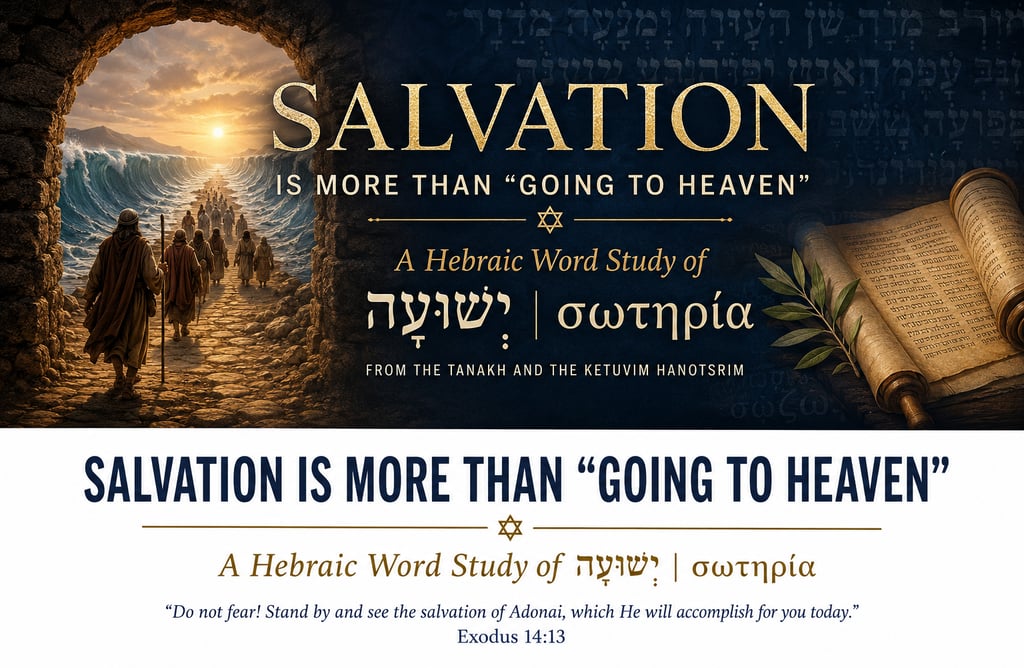
SALVATION IS MORE THAN “GOING TO HEAVEN”
A Hebraic Word Study of יְשׁוּעָה and σωτηρία
In much of modern Christianity, salvation is commonly reduced to a simple formula: a person believes certain facts about Yeishua, receives forgiveness, and is assured that he or she will go to heaven after death.
This understanding contains important biblical truths. We certainly need forgiveness, reconciliation with the Almighty, and deliverance from the consequences of sin. Nevertheless, the modern formula often falls far short of the fuller Hebraic and biblical meaning of salvation.
In Scripture, salvation is not merely a change in one’s destination after death. It is the Almighty’s act of rescuing people from bondage, danger, oppression, sin, corruption, death, and judgment. It includes restoration to covenant relationship, righteous living, communal responsibility, resurrection, the Kingdom of the Almighty, and ultimately the renewal of creation.
Biblical salvation is not merely about where we go when we die. It is about being rescued from what destroys life so that we may live faithfully before the Almighty.
A Necessary Caution About Word Studies
A word may have several possible meanings, but every possible meaning is not automatically present every time the word appears.
For example, the Greek verb translated “save” can refer to rescue from danger, healing from disease, preservation from death, or deliverance from sin. This does not mean that every occurrence simultaneously means “forgiven, healed, delivered, protected, and made whole.”
Context determines which aspect of the word is intended.
The deeper meaning of salvation, therefore, does not come from forcing every dictionary definition into every verse. It comes from tracing how the words are used throughout the biblical story.
The Hebrew Word Family
The principal Hebrew verb associated with salvation is:
יָשַׁע
yāshaʿ — to save, deliver, rescue, help, or bring to safety
The primary Hebrew noun is:
יְשׁוּעָה
yeshuʿah — salvation, deliverance, rescue, or victory
Another important form is:
מוֹשִׁיעַ
mōshiaʿ — one who saves; a deliverer or savior
The normal biblical sense of this word family is rescue from some form of danger, distress, oppression, defeat, or destruction. Some lexicons associate the root with the imagery of being brought from a confined or distressed condition into an open and secure place. However, its clearly demonstrated biblical meaning is deliverance or rescue.
This immediately gives salvation a broader and more concrete meaning than the idea of receiving a ticket to heaven.
The Exodus: The Foundational Picture of Salvation
One of the earliest and most important demonstrations of salvation occurs at the Sea of Reeds. Israel was trapped between Pharaoh’s army and the sea. Moshe told the people:
יְשׁוּעַת אֲדֹנָי
yeshuʿat Adonai — the salvation of Adonai
“Do not fear! Stand by and see the salvation of Adonai” (Exodus 14:13).
In this passage, salvation was not an abstract theological condition. Israel was about to be physically delivered from an army that intended to recapture or destroy them. The people could see their danger, and they would soon see the Almighty’s salvation.
The Hebrew text uses a form of yeshuʿah for this deliverance. The Greek Septuagint uses sōtēria, the same Greek word later used throughout the Ketuvim HaNotsrim for salvation. This connection is important because it demonstrates that the Greek writers of the Ketuvim HaNotsrim inherited their concept of salvation from Israel’s Scriptures and Israel’s history.
The Exodus also reveals an essential biblical pattern: the Almighty rescued Israel before bringing the people to Sinai.
Israel did not earn deliverance from Egypt by perfectly keeping the Torah. The Almighty acted because of His covenant faithfulness, compassion, and promises to Avraham, Yitzchak, and Ya‘akov. After rescuing Israel, He brought the people into covenant and taught them how a redeemed nation was to live.
Grace came first, but grace did not leave Israel without instruction. This shows us that the biblical concept of grace is not some kind of “spiritual non-stick coating” that allows sin to slide off without consequence. Grace is the undeserved favor of the Almighty, expressed not only through forgiveness but also through His provision, instruction, and power, which enable us to walk faithfully in His mitzvot. Grace does not excuse continued rebellion; it calls us out of rebellion and equips us to live in obedience.
Grace is also closely connected with mercy, although the two are distinct concepts. Biblical grace does not abolish our responsibility to live properly; it enables us to do so. Mercy is what the Almighty extends to us when we fall short. He has always provided a way for His people to repent, return to Him, receive forgiveness, and be restored.
The Almighty did not rescue Israel so that the people could continue living like Egyptians. He rescued them so that they could become His covenant people, live according to His commandments, and represent Him among the nations.
Salvation Produces a Redeemed Way of Life
The Torah explains that later generations were to tell their children that Israel had been Pharaoh’s slaves, but the Almighty brought them out of Egypt with a mighty hand. The commandments were then given for Israel’s good so that the people might continue to live before Him (Deuteronomy 6:20–25).
This sequence is crucial:
The Almighty rescues.
The Almighty establishes covenant relationship.
The Almighty gives His instructions.
The redeemed people respond with faithful obedience.
Obedience is not the purchase price of salvation. It is the proper response to salvation and the intended way of life for those who have been redeemed.
Modern theology sometimes separates salvation from obedience so sharply that salvation becomes little more than a legal declaration. Scripture does not confuse grace with works, but neither does it separate grace from the transformed life that grace is intended to produce.
Salvation Throughout the TaNaKh
Throughout the TaNaKh, salvation includes many forms of divine rescue.
David asks to be saved from violent enemies and military danger. The Psalms repeatedly describe the Almighty as a rock, fortress, refuge, deliverer, and source of salvation.
The judges of Israel are called deliverers because the Almighty used them to rescue Israel from oppression.
The prophets speak of salvation from exile, idolatry, uncleanness, injustice, national destruction, and covenant unfaithfulness.
Isaiah describes salvation going beyond the borders of Israel and reaching the ends of the earth (Isaiah 49:6). This does not require the replacement of Israel. Rather, the salvation promised to Israel becomes a light through which the nations may come to know the Almighty.
Salvation is therefore both individual and communal. It concerns persons, families, Israel as a people, and ultimately the nations.
Related Hebrew Ideas
No single Hebrew word contains the entire biblical doctrine of salvation. Scripture uses several related concepts to describe different aspects of the Almighty’s saving work.
גָּאַל
gāʾal — to redeem, especially as a kinsman-redeemer
פָּדָה
pādāh — to ransom or redeem from bondage
נָצַל
nātzal — to snatch away, rescue, or deliver from danger
שׁוּב
shuv — to turn or return
These concepts help fill out the biblical picture. Salvation includes rescue, redemption, release from bondage, return to the Almighty, restoration to the covenant community, and renewed faithfulness.
The Hebrew concept of teshuvah, repentance or return, is especially important. Salvation is not simply being declared innocent while continuing to walk away from the Almighty. The sinner is called to turn around, return, and begin walking in the Almighty’s ways.
The Promise of a Cleansed and Obedient People
Yechezqel (Ezekiel) describes Israel’s future restoration in language that brings cleansing, renewal, covenant, land, and obedience together.
The Almighty promises to cleanse Israel from uncleanness and idolatry, give the people a new heart, place His Spirit within them, and cause them to walk in His statutes and carefully observe His ordinances. He also promises that they will dwell in the land given to their ancestors and once again be His people (Ezekiel 36:24–28).
This is one of the clearest descriptions of salvation in the prophets.
Salvation includes forgiveness and cleansing, but it does not end there. The people are given new hearts so that they may walk faithfully in the Almighty’s instructions. The Spirit is not given to abolish the commandments but to enable the people to obey them.
The Greek Word Family
The principal Greek verb translated “save” is:
σῴζω
sōdzō — to save, rescue, preserve, deliver, or heal
The related noun is:
σωτηρία
sōtēria — salvation, safety, preservation, or deliverance
The word for a person who saves is:
σωτήρ
sōtēr — savior or deliverer
Outside narrowly religious contexts, these words could refer to being preserved from danger, surviving a disaster, being rescued from enemies, or recovering from sickness. The Greek vocabulary did not originally mean only “receiving forgiveness so that one can go to heaven.”
The Septuagint’s use of these Greek words to translate the Hebrew vocabulary of deliverance carried the story of the Exodus, the promises of the prophets, and Israel’s hope of restoration into the language of the Ketuvim HaNotsrim.
Saved from Sickness and Physical Danger
The Ketuvim HaNotsrim use sōdzō in situations where eternal destiny is not the immediate subject.
When Yeishua told the woman who had suffered from bleeding that her faith had “made her well,” the Greek text uses a form of sōdzō:
ἡ πίστις σου σέσωκέν σε
hē pistis sou sesōken se — your faith has saved you or made you well
In that context, she had been physically healed and restored from a condition that had also left her ceremonially unclean and socially isolated (Mark 5:25–34). Her salvation was physical, social, and personal.
In Acts 27:20, when Paul and the others were trapped in a violent storm at sea, Luke writes that they had abandoned hope of “being saved.” The immediate meaning was surviving the shipwreck. No one aboard was asking whether the storm had endangered his place in the world to come. They feared drowning.
These passages demonstrate the ordinary breadth of the word. To be saved is to be rescued from a genuine danger or destructive condition.
Yeishua Will Save His People from Their Sins
Matthew connects Yeishua’s name directly with salvation:
“You shall call His name Yeishua, for He will save His people from their sins” (Matthew 1:21).
The name commonly written:
יֵשׁוּעַ
Yeishua
is related to the Hebrew name:
יְהוֹשֻׁעַ
Yehoshua
The name points to the truth that Adonai saves.
The statement in Matthew does not disconnect Yeishua from Israel’s Scriptures. It presents him as the Almighty’s appointed Messiah and agent through whom the promised salvation is carried out. Just as the Almighty delivered Israel through Moshe and raised up judges as deliverers, He appointed Yeishua to accomplish a far greater deliverance.
Yeishua does not save people merely from the record of their sins. He saves his people “from their sins.”
Sin is not only a collection of past offenses requiring forgiveness. Sin is also a ruling power, a destructive way of life, a source of bondage, and a path leading toward death.
To be saved from sin therefore includes deliverance from its guilt, dominion, corrupting influence, destructive practices, and ultimate consequences.
Matthew’s wording is consistent with the prophets’ promise that Israel would be cleansed from idolatry, given a new heart, restored to covenant faithfulness, and enabled to walk in the Almighty’s commandments.
Salvation Is Not Permission to Continue in Sin
Sha’ul asks whether believers should continue in sin so that grace may increase. His answer is emphatic: “May it never be!” (Romans 6:1–2).
Those who have been delivered from slavery to sin are to become servants of righteousness. This is Exodus language applied to the power of sin. Humanity needs an exodus from a master more oppressive than Pharaoh.
Since Torah defines sin, salvation from sin cannot logically mean salvation from obedience to Torah. The Almighty does not rescue people from disobedience by teaching them that obedience is no longer important.
Salvation brings a person out of rebellion and into faithful submission to the Almighty.
Salvation Is by Grace, but It Has a Purpose
Sha’ul teaches that people are saved by grace through faith and not by works that would give anyone a reason to boast. Yet the next verse explains that those who are saved are created for good works, which the Almighty prepared for them to walk in (Ephesians 2:8–10).
Grace and obedience are not enemies.
Grace is the Almighty’s undeserved favor in giving us the strength and ability to live according to his ways and includes saving action. Obedience is the faithful response of those who have been rescued.
Titus similarly teaches that the grace of the Almighty trains believers to reject lawlessness and worldly desires and to live sensible, righteous, and reverent lives while awaiting the appearing of the Messiah (Titus 2:11–14).
Biblical grace does not merely pardon. Grace also instructs, disciplines, and transforms.
Salvation Has Past, Present, and Future Dimensions
Modern presentations sometimes speak of salvation as though it were completed entirely at the moment a person first believed. The Ketuvim HaNotsrim use more varied language.
Believers can speak of having been saved. Ephesians 2:8 describes salvation as something already received through grace.
Believers are also described as those who are “being saved.” First Corinthians 1:18 presents salvation as an ongoing work of the Almighty in the lives of His people.
Salvation is also future. Sha’ul tells believers that their salvation is nearer than when they first believed (Romans 13:11). Peter speaks of a salvation ready to be revealed in the last time (1 Peter 1:5).
We have been rescued from our former condition.
We are being transformed and preserved in the present.
We await the final deliverance that will come with resurrection, judgment, the reign of the Messiah, and the renewal of creation.
These are not three unrelated salvations. They are stages or dimensions of the Almighty’s one saving work.
Salvation Is More Than an Individual Experience
Western culture often treats salvation as a private transaction between the individual and the Almighty. Scripture certainly calls individuals to repent, believe, and walk faithfully. Nevertheless, biblical salvation is also corporate and communal.
The Almighty saved Israel as a people.
The prophets anticipated the restoration of Israel as a people.
Yeishua announced the coming Kingdom.
The emissaries formed covenant communities in which Jews and people from the nations learned to worship, serve, share, forgive, practice righteousness, and care for one another.
When salvation came to the house of Zacchaeus, the evidence was visible. He pledged to give to the poor and make restitution to those he had defrauded (Luke 19:1–10). Salvation transformed his use of money and his treatment of other people.
A salvation that produces no justice, mercy, restitution, generosity, faithfulness, or changed conduct is far removed from the biblical pattern.
Salvation Is Not Primarily Escape from the Earth
The popular idea of salvation often ends with the believer leaving the earth and living forever in heaven. Scripture’s final hope is larger.
The prophets speak of Israel’s restoration, the nations learning righteousness, peace among the peoples, and the knowledge of the Almighty filling the earth.
Daniel speaks of the resurrection of the dead.
Yeishua proclaims the Kingdom of the Almighty.
Sha’ul places great emphasis on bodily resurrection.
Revelation ends with renewed creation, the dwelling of the Almighty among humanity, the removal of death and mourning, and the restoration of all things.
The Scriptures do not deny the existence of the heavenly realm. However, their final destination is not a permanently disembodied existence separated from the earth. The biblical hope is resurrection and restored creation under the righteous rule of the Almighty through His appointed Messiah.
Salvation is not the abandonment of creation. It is the rescue and restoration of creation.
The Kingdom Dimension of Salvation
In the TaNaKh, salvation frequently includes the defeat of oppressive powers and the establishment of righteous rule. In the Ketuvim HaNotsrim, salvation remains closely connected with the Kingdom of the Almighty.
Yeishua did not travel throughout the land merely announcing a method for going to heaven. He announced the approaching Kingdom, called Israel to repentance, healed the sick, delivered the oppressed, forgave sins, confronted corruption, and gathered disciples who would live according to the values of that Kingdom.
His healings were signs of salvation because they demonstrated what happens when the Almighty’s rule confronts disease, uncleanness, oppression, and death.
His teachings were part of salvation because people must learn how citizens of the Kingdom are to live.
His death was part of salvation because he faithfully carried out the mission given to him, bore suffering on behalf of others, and inaugurated the promised renewed covenant.
His resurrection was part of salvation because death itself must be defeated.
His future return will bring the public and complete manifestation of the Kingdom that his followers presently anticipate.
What Are We Saved From?
According to the larger biblical story, the Almighty saves His people from slavery, oppression, enemies, danger, sickness, uncleanness, idolatry, sin, guilt, corruption, death, judgment, exile, alienation, and the powers that oppose His Kingdom.
What Are We Saved For?
We are saved for covenant relationship, faithful obedience, holiness, justice, mercy, worship, service, good works, life within the people of the Almighty, resurrection, participation in the Kingdom, and the restoration of creation.
Salvation is not merely removal from something bad. It is deliverance into something good.
Israel was brought out of Egypt so that the people might serve the Almighty.
Believers are delivered from slavery to sin so that they may become servants of righteousness.
We are not saved merely from death. We are saved for life.
A Hebraic Definition of Salvation
From a Hebraic and biblical perspective, salvation may be defined as:
The gracious and powerful action of the Almighty by which He rescues individuals, Israel, and people from the nations from bondage, oppression, sin, corruption, death, and judgment; restores them to covenant relationship and faithful living; and brings them toward resurrection, His Kingdom, and the renewal of creation through His appointed Messiah, Yeishua.
This definition is much greater than the statement, “I accepted Jesus, so I will go to heaven when I die.”
It includes forgiveness, but it does not end with forgiveness.
It includes faith, but it produces faithfulness.
It is given by grace, but it creates a people devoted to good works.
It rescues us from sin, but it also teaches us to walk in righteousness.
It begins in the present, but it looks toward the resurrection and the coming Kingdom.
It is personal, but it is never merely private.
It concerns the individual, but it also concerns Israel, the nations, and creation itself.
Conclusion
Biblical salvation is not a theological escape hatch. It is the Almighty’s great work of deliverance and restoration.
The Exodus provides its foundational pattern. The prophets enlarge its hope. Yeishua carries out his appointed role in the Almighty’s saving purpose. His resurrection announces that death will not have the final word. His future reign will bring the promised salvation toward its intended completion.
To be saved is to be rescued from the powers that enslave and destroy us. It is to be forgiven, cleansed, restored, and brought into covenant faithfulness. It is to leave the dominion of sin and begin walking in the ways of the Almighty.
Salvation is not merely about leaving this world someday.
It is about being rescued and transformed so that we may belong to the Almighty, serve Him faithfully, and participate in the life of His coming Kingdom.
Contact
Questions or thoughts? Reach out anytime.
Phone
gordon.hayes@torahwithgordon.org
+1 (325) 721-9304
© 2026. All rights reserved.