
The Danger of Reading Ancient Scripture Through Modern Assumptions
Paul’s warning about a coming “falling away” is often read through modern Christian assumptions, but the historical separation of Gentile believers from the Jewish, Torah-rooted faith of Yeishua fits the apostolic warnings with striking clarity. This study examines Scripture, history, and Jewish references to show why careful interpretation must begin in the world of the apostles rather than in later religious traditions.
HUMILITYAPOSTASYHERMENEUTICS
Gordon Hayes
7/12/20268 min read
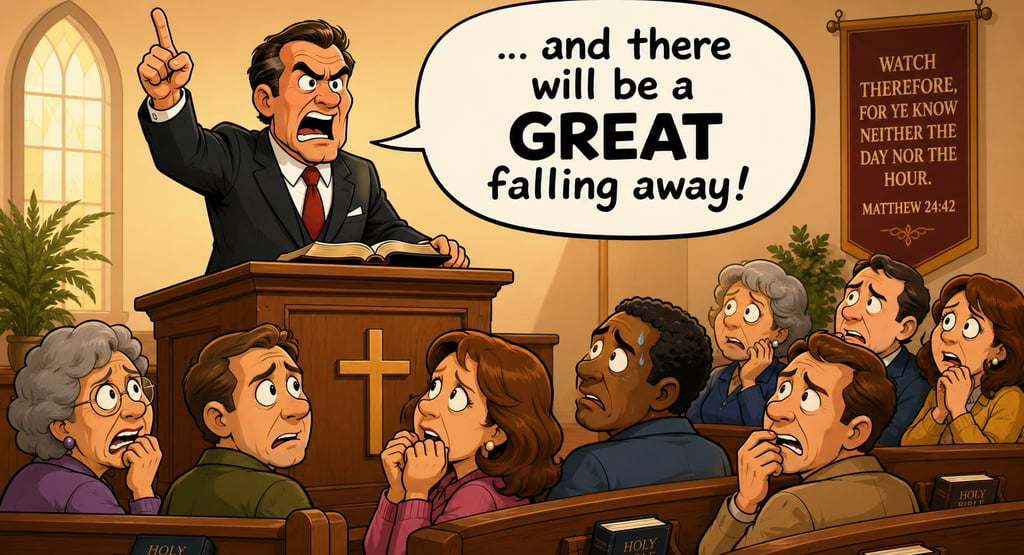

Paul’s warning about a coming “falling away” is often read through modern Christian assumptions, but the historical separation of Gentile believers from the Jewish, Torah-rooted faith of Yeishua fits the apostolic warnings with striking clarity. This study examines Scripture, history, and Jewish references to show why careful interpretation must begin in the world of the apostles rather than in later religious traditions.
One of the most common mistakes in Bible study is reading ancient texts through modern categories. We may sincerely believe we are simply “reading what the Bible says,” while unknowingly importing assumptions from our religious upbringing, denomination, culture, end-times system, or modern worldview.
This is especially true when we study passages about “apostasy,” “lawlessness,” and the warnings given by Yeishua and his emissaries concerning false teachers.
Many believers today read Paul’s warning in 2 Thessalonians 2 as though it must refer only to a great future collapse of Christianity just before the return of Messiah. That interpretation may contain a future element, but it often overlooks the historical setting of the warning and the apostolic concern that was already developing in the first century.
Paul wrote:
“Let no one in any way deceive you, for it will not come unless the apostasy comes first, and the man of lawlessness is revealed…”
— 2 Thessalonians 2:3, NASB95
But only a few verses later, Paul says:
“For the mystery of lawlessness is already at work…”
— 2 Thessalonians 2:7, NASB95
That phrase matters. Paul was not describing something wholly disconnected from his own time. He warned of something that would culminate later, but whose roots were already present.
The Meaning of Apostasy
The Greek word translated “apostasy” in 2 Thessalonians 2:3 is ἀποστασία (apostasia). It carries the idea of defection, rebellion, revolt, or falling away. Lexical summaries commonly define it as “defection,” “apostasy,” or “revolt,” and connect it with the verb aphistēmi, meaning to depart or fall away.
This word appears only twice in the Greek text of the Ketuvim haNotsrim. The other occurrence is Acts 21:21, where Paul is accused of teaching Jews among the nations “to forsake Moses,” telling them not to circumcise their children or walk according to the customs. Several literal translations render that accusation as “apostasy from Moses.”
That is extremely important.
In Acts 21, “apostasy” is not a vague emotional cooling off. It is a charge of abandoning Moses, circumcision, and the customs of Jewish covenant life. James and the elders in Jerusalem then instruct Paul to demonstrate publicly that this accusation is false and that he himself walks orderly, keeping the Torah.
So when Paul later warns about apostasia, we should not automatically read the term through later Christian theology. We should ask what “defection” would have meant in the apostolic world: a departure from the faith once delivered within the Jewish, Torah-rooted framework of Israel’s Scriptures.
Paul’s Warning to the Elders at Ephesus
Paul gave another serious warning when he spoke to the elders from Ephesus:
“I know that after my departure savage wolves will come in among you, not sparing the flock; and from among your own selves men will arise, speaking perverse things, to draw away the disciples after them.”
— Acts 20:29–30, NASB95
The “sheep’s clothing” wording is from Yeishua’s warning in Matthew 7:15, where he speaks of false prophets who appear harmless but are inwardly ravenous wolves. Paul’s warning in Acts 20 uses the same kind of shepherding imagery: wolves would come in among the flock, and some would even arise from within the community itself.
This was not a warning that outsiders alone would attack the faith. It was a warning that teachers would arise from within the believing community, distort the truth, and draw disciples after themselves.
That is exactly what happened as the faith of Yeishua was gradually severed from its Jewish and Torah-rooted foundation.
The Historical Falling Away from the Jewish Root
The earliest followers of Yeishua were Jews. They worshiped the God of Israel, read the Torah and Prophets, kept Shabbat, observed the appointed times, and understood Yeishua within the promises made to Israel.
This is not speculation. Eusebius, writing in the fourth century, preserves the tradition that the early leadership of the Jerusalem community was Hebrew. He says that until the time of Hadrian, the bishops of Jerusalem were “of Hebrew descent,” and that the Jerusalem community consisted of “believing Hebrews” from the days of the apostles until that time.
After the Bar Kokhba revolt and the Roman suppression of Jewish life in Jerusalem, the situation changed dramatically. Eusebius records that the bishops “of the circumcision” ceased at that time and that Jews were prohibited from going up to the area around Jerusalem.
This historical shift matters. The center of the Yeishua movement moved increasingly into Gentile hands. Over time, many Gentile believers did not merely join themselves to Israel’s Messiah; they began to define their faith over against the Jewish people, Jewish practice, and Torah.
By the middle of the second century, Justin Martyr’s Dialogue with Trypho shows that Torah-observant believers in Yeishua still existed, but their place within the broader Gentile church was becoming contested. Justin admits that some Christians would not even associate with believers who continued to observe the Law, though he personally disagreed with such rejection.
By the fourth century, the separation had hardened. In Eusebius’ record of Constantine’s letter concerning Easter, Constantine urges believers to have “nothing in common” with the Jews in determining the festival.
That is not the language of the apostles. It is the language of a later Gentile church increasingly hostile to the Jewish root of the faith.
Jewish References to the Split
Jewish sources also remember this separation, though from a different perspective.
The term minim in rabbinic literature was used for various kinds of sectarians or heretics. The Jewish Encyclopedia notes that, in passages referring to the Christian period, minim often included Judaeo-Christians, Gnostics, and Nazarenes. It also says that earlier friendly contact with such groups gradually gave way to hostility as these groups separated themselves from Jewish connection and circulated writings viewed as dangerous to Jewish unity.
The Jewish Encyclopedia article on the Nazarenes notes that Jewish tradition eventually used Noẓri as a designation for Christians and that the rabbis knew Judaeo-Christians such as Ebionites and Nazarenes.
The Birkat ha-Minim, the “benediction concerning heretics,” also reflects this painful separation. The Jewish Virtual Library notes that the tradition connects its formulation with Rabban Gamliel and Samuel ha-Katan at Yavneh, while also acknowledging scholarly debate about the exact process. Some Genizah forms of the blessing explicitly mention noẓerim and minim, though later censorship and changing circumstances altered the wording.
These Jewish references do not prove every detail of how the split occurred, but they do show that Jewish memory recognized a category of sectarian Jewish believers and later Christians who stood in a complicated and increasingly hostile relationship to the Jewish community.
The Warning of Romans 11
Paul warned Gentile believers not to become arrogant toward Israel.
He wrote that Gentile believers are like wild olive branches grafted into a cultivated olive tree. They do not support the root; the root supports them. Paul explicitly warns, “do not be arrogant toward the branches.”
This warning was not fully obeyed.
Much later Christian theology often acted as though the Gentile church had replaced Israel, superseded Torah, and become the new owner of the promises. Instead of receiving nourishment from the root, many tried to cut themselves off from the root and still claim the fruit.
That is not apostolic faithfulness. That is arrogance.
Why Modern Interpretation Often Misses This
Modern readers frequently assume that “Christianity” as they inherited it is essentially the same faith practiced by Yeishua and the apostles. From that assumption, they read the apostolic warnings as though Paul were warning about people falling away from later Christian creeds, church structures, or denominational systems.
But Paul was not a fourth-century bishop, a medieval theologian, a Reformation pastor, or a modern evangelical preacher. Paul was a Jewish emissary of Yeishua the Messiah. His Bible was the TaNaKh. His Messiah was the promised son of David. His theology was rooted in covenant, Israel, Torah, resurrection, and the hope of the kingdom.
When we read Paul through later anti-Torah assumptions, we distort him.
The “great falling away” may not be best understood as a future abandonment of modern Christianity alone. Historically, a strong case can be made that a great falling away already took place when the Gentile-dominated church separated itself from the Jewish people, the Torah, the appointed times, and the covenantal framework in which Yeishua and his emissaries lived and taught.
That does not mean every Gentile believer was wicked. It does not mean no truth remained in Christianity. It does not mean The Almighty abandoned sincere people who loved Him with the light they had.
But it does mean that a major historical defection occurred.
The faith of Yeishua was progressively redefined as something other than the faith of Israel.
Lawlessness Is Not a Small Matter
Paul calls this mystery “lawlessness.”
In modern Christianity, “law” is often treated as a negative word. But in Scripture, Torah is the instruction of The Almighty. To be “lawless” is not spiritual freedom. It is rebellion against divine instruction.
Yeishua warned:
“Not everyone who says to me, ‘Lord, Lord,’ will enter the kingdom of heaven… And then I will declare to them, ‘I never knew you; depart from me, you who practice lawlessness.’”
— Matthew 7:21, 23
That warning should sober us.
It is possible to use religious language, claim spiritual authority, and even perform impressive works while practicing lawlessness. Yeishua did not praise lawlessness. He rejected it.
A Better Way to Read the Text
A sound reading of 2 Thessalonians 2 should take several things seriously.
First, Paul said the mystery of lawlessness was already at work in his own day.
Second, the word apostasia carries the idea of defection or rebellion, and its other New Testament use concerns the accusation of abandoning Moses.
Third, Paul warned the Ephesian elders that dangerous teachers would arise from within the believing community.
Fourth, the historical record shows a real and painful separation between the Jewish followers of Yeishua and the increasingly Gentile church.
Fifth, Jewish sources remember categories such as minim, Noẓrim, Judaeo-Christians, Nazarenes, and related groups in ways that reflect this growing separation.
Taken together, these points suggest that Paul’s warning should not be limited to a future end-times collapse of modern Christianity. It should also be read as a warning about a Torah-rooted faith being distorted from within and separated from its Jewish foundation.
Returning Without Arrogance
Recognizing this history should not make us proud. It should make us humble.
Many of us inherited beliefs we did not invent. We were handed religious systems, vocabulary, traditions, and assumptions. When The Almighty opens our eyes to error, the proper response is not arrogance but repentance.
We should not mock Christians who do not yet see these things. Many love The Almighty sincerely. Many honor Yeishua with the understanding they have. But love must also tell the truth.
The faith of Yeishua is Jewish. The Scriptures are rooted in Israel. The covenants belong to Israel. The Messiah is the son of David. The Torah is The Almighty’s instruction. Gentiles who come to the God of Israel through Yeishua are grafted in; they do not become a replacement tree.
Conclusion: Reading as Ancient Disciples, Not Modern Inheritors
The danger of modern thinking is that it often begins with what we inherited and then forces Scripture to support it.
But faithful interpretation begins elsewhere.
It begins by asking what the text meant in its own language, context, history, and covenant setting. It listens to Moses, the Prophets, Yeishua, and the emissaries together. It refuses to make Paul contradict the Torah or the Messiah he served.
The great falling away may not be merely something still waiting in the future. In a very real historical sense, it happened when the faith of Yeishua was pulled away from its Jewish root and redefined as a religion separate from Torah, Israel, and the covenantal life of The Almighty’s people.
Our task is not to invent something new.
Our task is to return.
Not with arrogance.
Not with bitterness.
Not with hatred toward Christians or Jews.
But with humility, repentance, study, and obedience.
May The Almighty help us reject lawlessness, honor the Jewishness of our faith, and walk in the truth taught by Yeishua the Mashiach.
Contact
Questions or thoughts? Reach out anytime.
Phone
gordon.hayes@torahwithgordon.org
+1 (325) 721-9304
© 2026. All rights reserved.