
The Holy Spirit Told Me: Why Spiritual Impressions Cannot Replace Biblical Interpretation.
**Biblical hermeneutics** is the disciplined process of interpreting Scripture according to its language, grammar, literary context, historical setting, and intended audience. Prayer is essential for humility, wisdom, and obedience, but spiritual impressions must never replace careful study. Sound hermeneutics helps us draw meaning from the biblical text rather than reading our traditions, assumptions, or personal beliefs into it.
HERMENEUTICSPRAYERRUACH HAQODESHBIBLE STUDY
Gordon Hayes
7/20/202615 min read
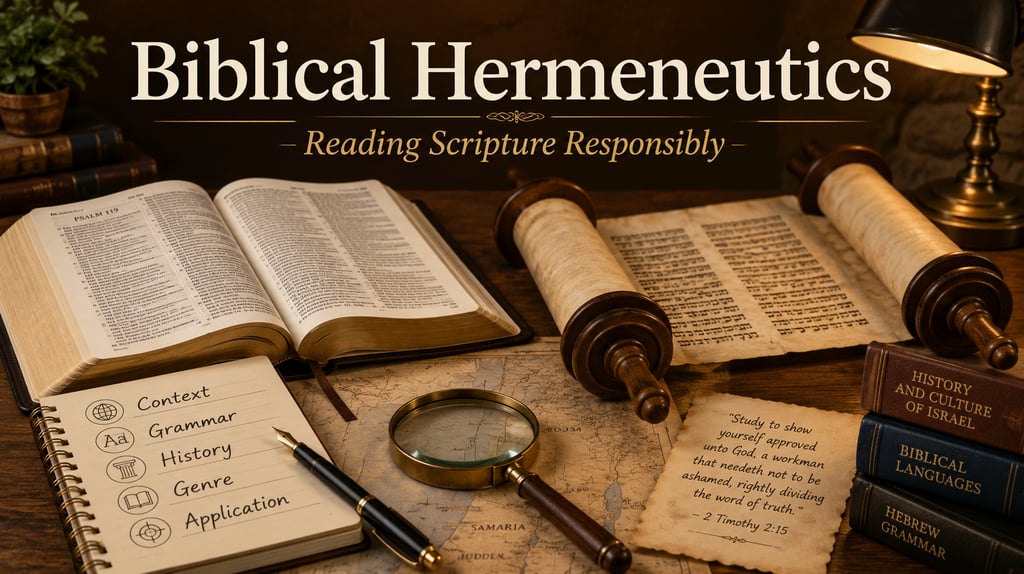
Reading Scripture Responsibly
Why Prayer Must Be Joined with Sound Biblical Hermeneutics
The Holy Bible was not written as a collection of disconnected sayings, inspirational quotations, or secret messages waiting for each reader to receive a private revelation. It is a library of ancient books written by different authors, in different historical settings, using Hebrew, Aramaic, and Koine Greek. It contains Torah, historical narrative, poetry, wisdom literature, prophecy, parables, letters, legal instruction, and apocalyptic imagery.
Because Scripture communicates through human language, it must be interpreted according to the ordinary rules by which language communicates meaning.
This disciplined process of interpretation is called hermeneutics.
Biblical hermeneutics refers to the principles and methods we use to determine what a passage meant in its original literary and historical setting before deciding what it means for us today. The goal is not to make the Bible say something meaningful to us. The goal is first to discover what the biblical text actually says.
That distinction is essential.
Many people sincerely pray before reading Scripture and then assume that whatever thought enters their mind must have been revealed by the “Holy Spirit.” Prayer is valuable, and we should certainly ask The Almighty for wisdom, humility, discernment, and a willingness to obey. Nevertheless, prayer is not a substitute for careful study.
Prayer should prepare us to interpret Scripture responsibly. It should never be used as permission to ignore grammar, context, history, or the original meaning of the text.
What Is Biblical Hermeneutics?
The word hermeneutics refers to the principles governing interpretation. Exegesis is the actual process of applying those principles to a particular passage.
Exegesis attempts to draw the meaning out of the text.
The opposite is commonly called eisegesis, which occurs when we read our own beliefs, experiences, assumptions, traditions, or desired conclusions into the text.
Every reader interprets. The question is not whether we will interpret the Bible, but whether we will interpret it carefully.
The grammatical-historical method seeks to understand a passage according to the normal meaning of its words, its grammatical structure, its literary form, and its historical setting. “Literal” interpretation does not mean that every expression must be understood in a woodenly literal manner. It means reading the text according to its normal literary sense, including its metaphors, idioms, symbols, poetry, and figures of speech.
This approach has a close parallel in the Jewish concept of peshat, the plain or contextual sense of Scripture. Peshat interpretation considers the language, syntax, immediate literary context, literary type, and interaction of these elements within the complete passage.
Recognized Principles of Biblical Interpretation
1. Begin with the Plain and Contextual Meaning
The first question should not be:
“What does this verse mean to me?”
The first question should be:
“What was the writer communicating to the original audience?”
The words of Scripture had meaning before we were born. That meaning does not change simply because a verse produces a particular feeling or reminds us of something in our personal lives.
A passage may have many legitimate applications, but those applications must grow out of what the passage actually communicates.
The plain sense does not rule out symbolism. A metaphor is interpreted metaphorically because that is its normal literary meaning. When the Psalms call The Almighty a rock, we do not imagine that He is composed of stone. When Scripture says that mountains clap their hands, we recognize poetic personification.
Interpreting the plain sense means respecting the kind of language the author chose to use.
2. Read Every Verse in Its Immediate Context
One of the most common interpretive errors is isolating a verse from the paragraph, argument, story, or discussion in which it appears.
A verse cannot normally be understood apart from:
The sentences immediately before it
The sentences immediately after it
The larger section of the book
The overall purpose of the book
For example, Philippians 4:13—“I can do all things through Him who strengthens me”—is frequently used as a promise that a believer can accomplish anything he desires. The surrounding context, however, concerns learning to remain content during abundance, hunger, prosperity, and hardship. The statement is about receiving strength to remain faithful in changing circumstances, not receiving unlimited ability to achieve every personal ambition.
Matthew 18:20—“Where two or three have gathered together in My name, I am there in their midst”—is often presented as a general statement about small worship gatherings. Its immediate context concerns witnesses, communal judgment, discipline, and resolving offenses.
Likewise, Peter explicitly explained the meaning of his vision in Acts 10:
“The Almighty has shown me that I should not call any man common or unclean” (Acts 10:28).
The surrounding narrative repeatedly identifies people—not formerly prohibited animals—as the subject of the vision’s application.
Context protects us from using isolated sentences to teach ideas the writer was not discussing.
3. Identify the Literary Genre
The Holy Bible contains many different kinds of literature. Each must be interpreted according to its own literary conventions.
Historical narrative recounts events. Torah gives covenantal instruction. Proverbs express general principles of wisdom. Poetry uses parallelism, imagery, exaggeration, and emotional language. Prophecy may combine immediate historical warnings with future expectations. Parables communicate through comparison. Letters address particular communities and circumstances. Apocalyptic literature uses visions, symbols, creatures, numbers, and cosmic imagery.
Mistaking one genre for another can produce serious misunderstanding. Recognizing literary forms is therefore considered essential to responsible biblical interpretation.
Consider the following examples:
“The trees of the field will clap their hands” is poetry, not botany.
“The whole world has gone after him” is ordinary exaggeration, not a mathematical population count.
Proverbs are generally reliable principles, but they are not necessarily unconditional promises applying identically in every circumstance.
A symbolic creature in Revelation should not automatically be interpreted as a literal zoological animal.
A parable should not be pressed so that every minor detail becomes a separate doctrine.
Genre tells us what kind of communication we are reading and how that communication functions.
4. Study Grammar, Syntax, and Word Usage
Words do not possess meaning in isolation. Their meaning is determined by how they are used in a sentence and context.
This is why biblical interpretation must pay attention to:
Verb tense and aspect
Singular and plural forms
Pronouns and their antecedents
Prepositions
Conjunctions
Sentence structure
Parallelism
Repeated expressions
Contrasts and comparisons
Word studies can be valuable, but they are also frequently abused.
A word does not necessarily mean everything it could possibly mean every time it appears. The interpreter must determine which meaning fits the particular sentence.
We must also avoid the root fallacy—the assumption that a word’s meaning is always contained in its historical roots or component parts. The English word “butterfly” does not describe a fly made from butter. In the same way, dividing a Hebrew or Greek word into smaller pieces does not automatically reveal how the word was used by the biblical writer.
Neither should we assume that an English word must carry the same meaning in every verse. Words such as law, faith, spirit, world, flesh, works, and salvation may be used differently depending on the author and context.
A concordance shows where a word appears. It does not, by itself, determine what the word means in every passage.
5. Consider the Historical and Cultural Setting
The biblical writings arose within the cultures of the ancient Near East, ancient Israel, Second Temple Judaism, the Greek-speaking eastern Mediterranean, and the Roman Empire.
Understanding those settings can clarify:
Marriage customs
Covenant language
Agricultural practices
Inheritance laws
Sacrificial procedures
Forms of government
Social relationships
Jewish sectarian disputes
Roman legal practices
Idioms and figures of speech
Religious controversies
Geography and travel
Knowledge of ancient Near Eastern history and culture can deepen our understanding of the documents that comprise the Hebrew Bible.
For example, Yeishua’s teachings must be read within the world of late Second Temple Judaism. His discussions concerning Shabbat, purity, divorce, resurrection, taxation, and the greatest commandment occurred within existing Jewish debates. Reading those conversations as though Yeishua were a modern Western Christian arguing against “Judaism” produces distorted conclusions.
Historical background must remain a servant of the text. It should help illuminate what the passage communicates, not be used to dismiss inconvenient statements.
6. Identify the Speaker, Audience, and Purpose
Not every statement recorded in Scripture expresses the position of the biblical writer or the will of The Almighty.
The serpent speaks in Genesis. Pharaoh speaks in Exodus. Job’s companions offer lengthy explanations that The Almighty eventually rebukes. Ecclesiastes records observations from different perspectives. The adversary speaks in the book of Job and during the temptation of Yeishua.
Therefore, we must ask:
Who is speaking?
To whom is he speaking?
Under what circumstances?
What question is being answered?
Is the statement approved, corrected, or merely reported?
What is the author trying to demonstrate by including it?
We must also distinguish between words addressed to a particular person and instructions intended for the covenant community more broadly.
The command given to Noah to build an ark is not a standing command for every reader. The command against murder, by contrast, is repeatedly presented as a moral requirement.
Audience and purpose help us determine the proper scope of a passage.
7. Interpret Scripture in Light of Scripture
No passage exists independently of the rest of Scripture.
The Torah provides the foundational vocabulary and covenantal framework for the Prophets, Writings, and Ketuvim HaNotsrim. Later writers repeatedly quote, summarize, allude to, and reason from earlier Scripture.
This means that we should compare:
Parallel accounts
Repeated instructions
Earlier uses of important expressions
Direct quotations
Allusions
Thematic connections
Explanations supplied elsewhere in Scripture
Scripture should be allowed to interpret Scripture, but this principle must not be abused. It does not mean collecting verses containing the same English word and combining them without regard for context.
It also does not mean using a difficult later passage to overturn the clear meaning of an earlier command.
Later biblical writers may explain, apply, or extend the significance of earlier revelation, but they should not be interpreted as making the earlier text mean the opposite of what it originally communicated.
8. Interpret Difficult Passages in Light of Clear Passages
Not every passage is equally easy to understand.
Some texts contain rare words, difficult grammar, unfamiliar customs, textual variations, symbolic imagery, or abbreviated arguments. Peter acknowledged that some of Paul’s writings contained matters that were difficult to understand and could be distorted by the untaught and unstable (2 Peter 3:15–16).
A responsible interpreter does not build a major doctrine on:
One disputed translation
One obscure verse
One symbolic vision
One difficult grammatical construction
One passage that appears to contradict many clear passages
Clear, repeated teachings should help guide our understanding of less certain texts.
This does not permit us to ignore difficult passages. It requires us to hold our conclusions with appropriate humility and to avoid making the uncertain control the certain.
9. Distinguish Description from Instruction
The Bible records many actions without approving them.
The fact that Abraham, Jacob, David, or Solomon did something does not automatically make that action righteous. Scripture records deception, violence, polygamy, political intrigue, idolatry, and personal failure because it truthfully reports human conduct.
Narrative answers the question:
“What happened?”
Instruction answers the question:
“What should be done?”
Sometimes the narrator evaluates an action directly. At other times, the consequences or the larger biblical context reveal the evaluation.
We must therefore avoid turning every historical event into a command or approved pattern.
Similarly, not every practice found in the book of Acts automatically becomes a universal requirement. We must examine whether the practice was commanded, repeated, explained, or merely reported.
10. Distinguish Interpretation from Application
Interpretation asks:
“What does the passage mean?”
Application asks:
“How should we respond?”
These questions are related, but they are not identical.
A passage may have one primary meaning within its original context while supporting several legitimate applications.
For example, the command not to muzzle an ox while it is threshing directly concerns the humane treatment of a working animal. Paul later reasons from that command to the principle that laborers—including teachers—should receive material support. The application grows from the moral principle expressed in the Torah. It does not erase the command’s original agricultural meaning.
Application must follow interpretation.
When application comes first, we are easily tempted to reshape the passage around our personal needs, current controversies, political opinions, or denominational traditions.
11. Recognize Idioms, Figures of Speech, and Symbolism
Biblical languages contain idioms that may sound strange when translated literally.
Examples include:
“Hardening the heart”
“Uncovering nakedness”
“Lifting the face”
“Cutting a covenant”
“Son of”
“Hating” in a comparative context
“All the world”
“Forever” in relation to an age or continuing arrangement
Figures of speech are not errors or evasions. They are normal forms of human communication.
The “literal” or normal sense of Scripture includes recognizing when the writer is using:
Metaphor
Simile
Hyperbole
Personification
Irony
Symbolism
Parallelism
Rhetorical questions
A symbolic interpretation is justified when the literary form and context indicate symbolism. It is not justified merely because the literal meaning is uncomfortable or conflicts with our theology.
12. Examine Our Own Assumptions
No reader approaches Scripture without presuppositions.
We bring assumptions shaped by:
Family
Culture
Language
Religious upbringing
Denominational teaching
Political views
Personal experiences
Popular sermons
Traditional translations
Responsible interpretation requires us to identify these influences and allow Scripture to correct them.
This is especially important when we have heard a particular explanation repeated so often that it feels as though it must be stated directly in the Bible.
Familiarity is not proof.
Tradition can preserve valuable insight, but tradition must still be examined. Modern scholarship can provide useful linguistic and historical information, but scholars must also be evaluated. Neither tradition nor scholarship is infallible.
The interpreter should listen respectfully to others while keeping the biblical text in the position of final authority.
Disciplined Interpretation Has Jewish Roots
Rule-governed interpretation is not a modern attempt to remove faith from Bible study.
Jewish teachers developed recognized methods for interpreting and applying Scripture. The seven interpretive rules traditionally associated with Hillel include:
Qal va-chomer — reasoning from the lesser to the greater or from the greater to the lesser
Gezerah shavah — reasoning by verbal or conceptual analogy
Binyan av from one text — establishing a general principle from one passage
Binyan av from two texts — establishing a principle from two related passages
General and particular — interpreting general statements through particular examples and vice versa
Comparison with another passage — clarifying one text through a similar text
Davar ha-lamed me-inyano — interpreting a matter from its context
These rules demonstrate that Jewish interpretation was understood as a disciplined activity governed by recognizable forms of reasoning.
Yeishua himself frequently used qal va-chomer reasoning:
“If you, being evil, know how to give good gifts to your children, how much more will your Father who is in heaven give what is good to those who ask Him?”
—Matthew 7:11
He also asked:
“What is written in the Torah? How does it read to you?”
—Luke 10:26
The question was not merely whether the man had read the words. Yeishua asked how he understood the text.
Why Prayer Alone Is Not a Method of Interpretation
Prayer is appropriate and necessary to a faithful life. We should ask The Almighty to give us wisdom, correct our pride, expose our prejudices, and help us obey what we learn.
But prayer alone does not establish the meaning of a passage.
Sincere People Reach Contradictory Conclusions
People on opposing sides of nearly every theological controversy claim that the “Holy Spirit” revealed the truth to them.
One person says the Spirit showed him that Torah was abolished. Another says the Spirit showed him that Torah remains valid.
One says Yeishua is The Almighty. Another says Yeishua is the human Messiah and authorized agent of The Almighty.
One says the dead are conscious. Another says they remain unconscious until resurrection.
Contradictory propositions cannot all be correct in the same sense at the same time.
Sincerity does not guarantee accuracy.
A person may sincerely misunderstand grammar, overlook context, repeat an inherited tradition, or mistake an emotional impression for divine instruction.
Private Impressions Cannot Be Objectively Tested
When someone says, “The Holy Spirit showed me what this verse means,” how can the claim be tested?
If the interpretation does not arise from the words, grammar, context, or historical setting, the claim becomes immune to examination. Any disagreement can then be dismissed as spiritual blindness.
That is dangerous.
The Bereans were praised because they examined the Scriptures daily to determine whether Paul’s message was correct (Acts 17:11). They did not accept his claims merely because he presented himself as being guided by the Spirit.
Paul likewise instructed his readers to “test all things” and hold fast to what is good (1 Thessalonians 5:21).
A claim of spiritual guidance must not be used to prevent scriptural examination.
Scripture Commands Study and Careful Explanation
Ezra “set his heart to study the Torah of Adonai, to practice it, and to teach” it in Israel (Ezra 7:10).
The order is significant:
Study
Practice
Teach
When the Torah was publicly read in Nehemiah’s day, the Levites did more than pray for the people to understand:
“They read from the book, from the Torah of The Almighty, explaining and giving insight, and they provided understanding of the reading.”
—Nehemiah 8:8
The text was read, explained, and made understandable. Nehemiah 8 presents interpretation and teaching as necessary parts of helping the people comprehend Scripture.
The Ethiopian official in Acts 8 was reading Isaiah. When Philip asked whether he understood, the man answered:
“How could I, unless someone guides me?”
—Acts 8:31
The passage does not criticize him for failing to pray until the meaning appeared. Philip explained the text.
Timothy was instructed to be diligent in handling the word of truth accurately (2 Timothy 2:15). Peter warned that Scripture could be twisted (2 Peter 3:16).
These passages assume that interpretation requires care, instruction, diligence, and accountability.
The Spirit Does Not Contradict the Text
The holy spirit of The Almighty does not inspire a written message and then reveal an interpretation that contradicts the language of that message.
The Spirit may convict us through Scripture. The Spirit may help us recognize the importance of a passage. The Spirit may expose our resistance to obeying what we have read.
But conviction and interpretation are not identical.
A personal impression may concern how we should apply a passage. It cannot change what the passage originally meant.
The statement “The Spirit showed me” should therefore produce humility, not immunity from correction.
A better statement would be:
“After examining the language, context, historical background, and related passages, this is how I presently understand the text. I remain willing to be corrected by stronger evidence.”
That approach honors both Scripture and The Almighty.
Common Interpretive Errors
Proof-Texting
Proof-texting occurs when a verse is removed from its context and used to support a pre-existing belief.
The verse may contain words related to the subject, but that does not mean the writer was addressing the doctrine being attached to it.
Reading Theology into the Text
An interpreter may begin with a doctrinal system and force every passage to conform to it.
When a passage appears inconsistent with the system, the plain meaning is redefined, spiritualized, or dismissed.
Sound theology should be built from careful interpretation. Interpretation should not be controlled by a theology that is never permitted to be questioned.
Arbitrary Allegorizing
Allegory may be appropriate when the text presents itself as allegorical or when Scripture explains the symbolism.
Arbitrary allegorizing occurs when interpreters assign hidden meanings to details without textual evidence. Five stones become five ministries. A rope becomes faith. A window becomes revelation. The interpretation comes from the imagination of the teacher rather than the text.
Treating a Translation as the Original Text
Every translation involves interpretation.
Comparing several responsible translations can reveal where translators understand the Hebrew or Greek differently. Serious disagreements should lead us to examine the original wording, grammar, textual notes, and scholarly discussion.
No English translation should be treated as though its wording descended directly from heaven.
Confusing “What It Says to Me” with “What It Means”
A passage may remind us of a personal situation. That association can be useful for reflection, but it does not establish the passage’s meaning.
Personal significance must remain subordinate to textual meaning.
A Practical Method for Studying a Biblical Passage
Before reaching a conclusion, work through the following questions:
1. Read the entire passage several times
Do not begin with a single verse. Read the paragraph, chapter, and surrounding section.
2. Identify the literary genre
Determine whether the text is Torah, narrative, poetry, prophecy, wisdom, parable, letter, or apocalyptic literature.
3. Identify the speaker and audience
Ask who is speaking, who is being addressed, and what circumstances produced the statement.
4. Observe the structure
Look for repeated words, contrasts, cause-and-effect relationships, questions, answers, commands, conclusions, and changes in subject.
5. Compare several translations
Note meaningful differences. Do not automatically assume that your preferred translation is correct in every instance.
6. Examine important words in context
Use lexicons and concordances carefully. Determine how the author uses the word rather than merely collecting every possible dictionary definition.
7. Research the historical setting
Study relevant geography, customs, political conditions, Jewish practices, and ancient institutions.
8. Compare related passages
Examine genuine parallels, quotations, and allusions while preserving the context of each passage.
9. Consult qualified teachers and commentaries
Commentaries are tools, not authorities equal to Scripture. Compare multiple perspectives and examine their evidence.
Even statements advocating grammatical-historical interpretation acknowledge that ordinary readers need not be wholly dependent on scholars while warning that they should not ignore the fruits of careful technical study.
10. State the interpretation before making an application
Summarize in one or two sentences what the passage communicated within its original setting. Only then ask how its instruction or principle should affect us today.
Prayer and Study Belong Together
This discussion should not be interpreted as an argument against prayer.
We should pray before studying Scripture.
We should pray while studying Scripture.
We should pray after studying Scripture.
But what should we request?
We should ask The Almighty for:
Humility to admit when we are wrong
Patience to study difficult passages
Protection from pride and prejudice
Wisdom to recognize sound evidence
Courage to reject inherited errors
Willingness to obey what the text actually teaches
Love toward those who reach different conclusions
Discernment to distinguish interpretation from imagination
Prayer should change the interpreter. It should not be used to change the meaning of the text.
The person who prays but refuses to examine context is not demonstrating greater spirituality. The person who claims revelation while ignoring grammar is not honoring the Spirit who communicated through language.
The Almighty gave us minds capable of reading, comparing, reasoning, remembering, and learning. Using those abilities responsibly is not a lack of faith. It is an act of stewardship.
Conclusion
Biblical hermeneutics does not remove The Almighty from Bible study. It helps remove us—our assumptions, traditions, preferences, and imaginations—from the position of controlling the text.
We do not study the rules of interpretation because Scripture is powerless. We study them because Scripture deserves to be heard accurately.
We pray because we need humility, wisdom, and the strength to obey.
We study because the biblical message was communicated through real languages, writers, cultures, literary forms, and historical circumstances.
We test our conclusions because sincere people can be mistaken.
We listen to other students and teachers because none of us possesses perfect understanding.
Most importantly, we allow the text to correct us rather than continually reshaping the text to confirm what we already believe.
The question is not merely:
“Have I prayed about this passage?”
We must also ask:
“Have I read it in context?”
“Have I considered its grammar and historical setting?”
“Have I identified its literary form?”
“Have I compared related passages fairly?”
“Can my interpretation be demonstrated from the text?”
“Am I willing to change my belief if the evidence requires it?”
Prayer and disciplined study are not enemies.
Prayer produces the humility required for responsible interpretation. Hermeneutics provides the tools needed to interpret responsibly. Obedience demonstrates that we have taken the message seriously.
As Ezra’s example teaches us, we must set our hearts to study the Torah, to practice it, and then to teach it faithfully.
Selected Resources for Further Study
Bacher, W., & Lauterbach, J. Z. “Rules of Hillel, the Seven.” Jewish Encyclopedia.
Fee, G. D., & Stuart, D. (2014). How to Read the Bible for All Its Worth (4th ed.). Zondervan Academic.
International Council on Biblical Inerrancy. (1982). The Chicago Statement on Biblical Hermeneutics. While readers may disagree with some of its theological affirmations, its discussions of context, genre, grammar, literary form, and responsible interpretation remain useful methodological observations.
Lockshin, M. (2021). “On the Origins of Peshat Commentary.” TheTorah.com.
Terry, M. S. (1883). Biblical Hermeneutics: A Treatise on the Interpretation of the Old and New Testaments. Phillips & Hunt.
Contact
Questions or thoughts? Reach out anytime.
Phone
gordon.hayes@torahwithgordon.org
+1 (325) 721-9304
© 2026. All rights reserved.