The Many Faces of Biblical Worship: Part 1 - What is Worship?
When most people think of worship, they think of music. While singing is certainly an important expression of worship, the Scriptures present a much richer picture. Through the Hebrew and Greek words translated as "worship," we discover that true worship encompasses every aspect of our relationship with The Almighty—our reverence, our service, our obedience, and our daily walk before Him.
TORAH STUDYWORSHIP
Gordon Hayes
7/13/20264 min read
More Than Singing: The Many Faces of Biblical Worship: Part 1
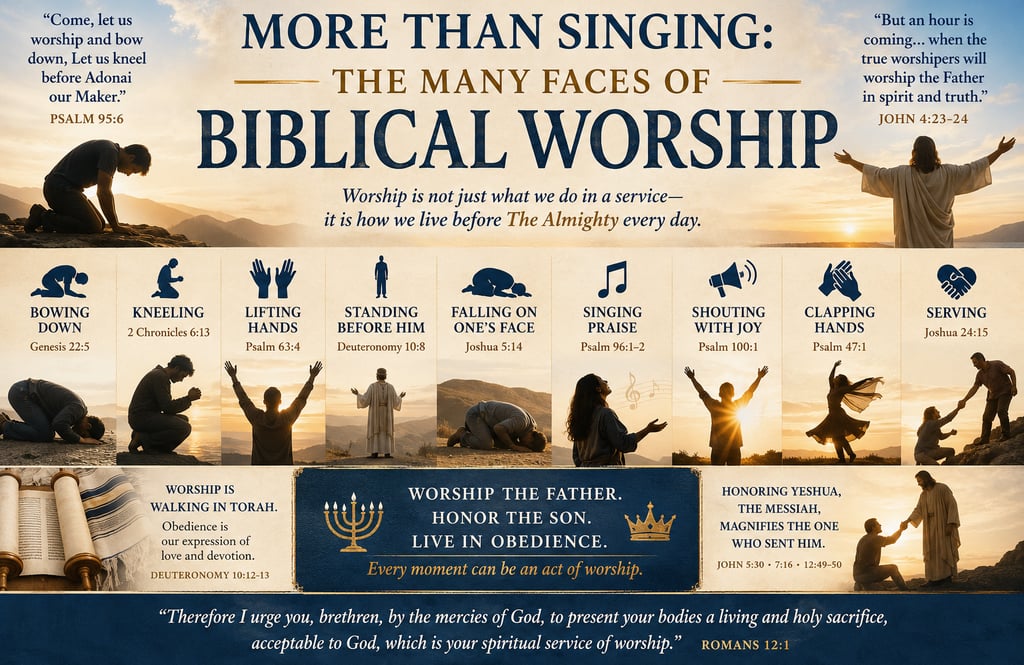
When most people hear the word worship, they immediately think of music. Congregational singing, choirs, worship teams, or a favorite hymn often come to mind. While music certainly has an important place in worship, the Scriptures present a much broader and richer picture.
Many of the Hebrew and Greek words translated "worship" have little to do with music at all. Instead, they describe humility, reverence, service, thanksgiving, obedience, and wholehearted devotion to The Almighty.
Understanding these words opens an entirely new dimension of our walk with Him. Worship becomes more than something we do for an hour on Shabbat or the first day of the week. It becomes a way of life.
Worship Begins with Humility
Perhaps the primary Hebrew word translated worship is:
שָׁחָה
shāḥâ
Its basic meaning is:
to bow down
to prostrate oneself
to stoop low
to show honor
to pay homage
The first occurrence appears when Abraham tells his servants:
Genesis 22:5 (NASB95)
"Stay here with the donkey, and I and the lad will go over there; and we will worship and return to you."
Notice something remarkable.
There is no music, no instruments, and no choir.
Abraham's worship consisted of humble obedience as he prepared to offer Isaac in faith.
The emphasis is not on emotion but on submission.
Throughout Scripture, whenever people fall upon their faces before The Almighty, bow in His presence, or humble themselves before His majesty, they are expressing this biblical concept of worship.
True worship begins when we recognize who He is—and who we are.
Worship Is Service
Another important Hebrew word is:
עָבַד
ʿābad
This word is commonly translated:
serve
labor
work
minister
Yet in many passages it is also translated worship.
When The Almighty commanded Moses to confront Pharaoh, He repeatedly declared:
"Let My people go, that they may serve Me."
The Hebrew word translated serve is ʿābad.
Israel was not merely being released from slavery.
They were being redeemed for a purpose.
The Almighty did not simply free Israel from bondage; He freed them for covenant service.
Their service to Pharaoh would become service to The Almighty.
This teaches us something profound.
Worship is not confined to a sanctuary or religious gathering.
It is faithful service throughout everyday life.
Every act of obedience becomes worship.
Every commandment lovingly observed becomes worship.
Every opportunity to serve another person becomes worship.
The Apostle Paul later expressed this same principle when he wrote:
Romans 12:1 (NASB95)
"Therefore I urge you, brethren, by the mercies of God, to present your bodies a living and holy sacrifice, acceptable to God, which is your spiritual service of worship."
The sacrifice is no longer an animal upon an altar.
The sacrifice is ourselves.
Worship Is Reverence
Another important Hebrew word is:
יָרֵא
yārēʾ
Its basic meaning is:
to fear
to revere
to stand in awe
Modern readers often misunderstand what Scripture means by "the fear of The Almighty."
Biblical fear is not terror.
It is profound reverence.
It is recognizing His absolute holiness, His perfect justice, His boundless mercy, and His sovereign authority over all creation.
A person who truly fears The Almighty does not ask,
"How little must I obey?"
Instead, he asks,
"How can I honor Him more faithfully?"
Such reverence naturally produces worship.
Worship Includes Thanksgiving
Another beautiful Hebrew word is:
תּוֹדָה
tôdâ
It means:
thanksgiving
confession
gratitude
The thank offering itself was called a todah offering.
Giving thanks in Scripture is much more than polite manners.
It is an acknowledgment that every blessing comes from The Almighty.
Nothing we possess ultimately originates with us.
Every good gift is received from His gracious hand.
Gratitude transforms the heart.
A thankful heart is difficult to make bitter.
A thankful heart learns contentment.
A thankful heart naturally worships.
David repeatedly connected thanksgiving with worship.
Psalm 100:4 (NASB95)
"Enter His gates with thanksgiving and His courts with praise. Give thanks to Him, bless His name."
Thanksgiving prepares the heart for worship because it reminds us that everything we have comes from Him.
Worship Includes Praise
Perhaps no Hebrew word is more familiar than:
הָלַל
hālal
From this word comes the joyous expression:
הַלְלוּ־יָהּ
Hallelujah
"Praise Yah!"
The basic meaning includes:
to praise
to celebrate
to boast
to shine forth
The Book of Psalms overflows with this kind of worship.
David sang.
Musicians played.
Trumpets sounded.
Voices rejoiced.
Hands clapped.
The congregation praised together.
Praise is certainly an important expression of worship.
But it is not worship in its entirety.
Rather, praise is one beautiful expression of a heart already devoted to The Almighty.
The Greek Picture of Worship
The Ketuvim HaNotsrim continue these same themes.
The primary Greek word translated worship is:
προσκυνέω
proskyneō
Literally it means:
to bow down
to fall before someone
to kiss toward
to pay homage
The image is striking.
A subject approaches a great king.
He bows.
He kneels.
He lowers himself.
He acknowledges the king's authority.
Again, the emphasis is not music but humble submission before rightful authority.
Worship Through Sacred Service
Another important Greek word is:
λατρεύω
latreuō
It means:
to serve
to minister
to render sacred service
Paul frequently employs this language.
Our worship is not confined to ceremonies or holy days.
It includes lives devoted to serving The Almighty.
This transforms even the ordinary routines of life.
Honest work.
Caring for one's family.
Showing kindness to a stranger.
Keeping one's word.
Observing the commandments.
Serving within one's congregation.
All of these become acts of worship when they are done for the honor of The Almighty.
This understanding removes worship from a single location or event and places it into every moment of daily life.
Worship becomes a lifestyle rather than merely an activity.
A Beautiful Pattern
As we examine these Hebrew and Greek words together, a beautiful pattern begins to emerge.
Worship is not simply something we attend.
It is something we become.
It is expressed through humility.
Through reverence.
Through gratitude.
Through faithful service.
Through obedience.
Music certainly has an honored place within worship.
But the biblical picture is far larger.
The Scriptures invite us to worship The Almighty with our voices, our hands, our knees, our work, our prayers, our possessions, our relationships, and ultimately our entire lives.
In the next section, we will see these truths illustrated through the lives of God's people as we examine the many biblical expressions of worship recorded throughout the Scriptures.
Contact
Questions or thoughts? Reach out anytime.
Phone
gordon.hayes@torahwithgordon.org
+1 (325) 721-9304
© 2026. All rights reserved.