The Wisdom of the Hebrew Aleph Bet
The Hebrew aleph-bet is more than a collection of symbols used to record words. Its sounds, forms, numerical values, and place within Scripture have inspired generations of Jewish teachers to discover lessons about wisdom, truth, creation, and our relationship with The Almighty. This introductory study explores how the letters can deepen our appreciation of Scripture, using Aleph and Shin as examples.
TORAH STUDYHEBREW
Gordon Hayes
7/17/20269 min read
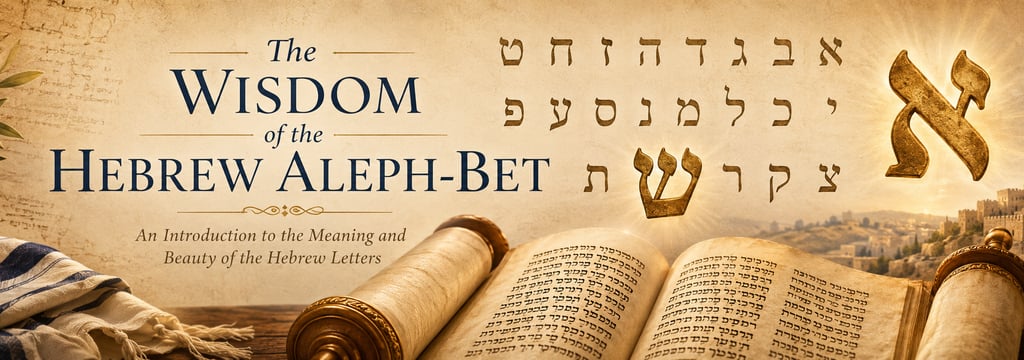
The Wisdom of the Hebrew Aleph-Bet
An Introduction to the Meaning and Beauty of the Hebrew Letters
More Than an Alphabet
For many students, learning biblical Hebrew begins with memorizing unfamiliar shapes and sounds.
Aleph.
Bet.
Gimel.
Dalet.
At first, the letters may seem like obstacles standing between us and the biblical text. Yet as we grow more familiar with them, we begin to recognize that the Hebrew aleph-bet is not merely a code that must be deciphered. It is the vehicle through which much of the revelation of The Almighty has been preserved.
The Hebrew aleph-bet consists of twenty-two primary letters. Five of these—Kaf, Mem, Nun, Peh, and Tzade—have special forms when they occur at the end of a word. The letters also function as numbers, with Aleph representing one, Bet representing two, and so forth.
The name aleph-bet comes from the first two Hebrew letters:
א ב
Aleph-Bet
The sages of the Talmud even offered a playful homiletical interpretation of these first two letters. They associated Aleph-Bet with the expression elaf binah—“learn understanding” or “learn wisdom.” This was not presented as the grammatical meaning of the letters, but as a memorable spiritual lesson drawn from their sounds.
That interpretation provides an appropriate invitation for every student:
Do not merely memorize the aleph-bet.
Allow it to lead you into wisdom.
Letters, Words, and Revelation
The Scriptures repeatedly emphasize the importance of the spoken and written word.
The Almighty creates through speech in Genesis 1. He speaks, and creation responds. The Torah is written so that it may be read, remembered, taught, and obeyed. The prophets repeatedly introduce their messages by declaring that the word of Adonai came to them.
The Hebrew letters are the building blocks through which those words are recorded.
Jewish tradition developed many ways of contemplating the letters. Teachers considered:
the name of a letter;
its sound;
its position in the aleph-bet;
its numerical value;
its written form;
words that begin or end with it;
and its relationships with other letters.
These approaches appear in midrash, Talmudic discussion, medieval commentary, and Jewish mystical literature. One of the earliest and most influential mystical works, Sefer Yetzirah, portrays the twenty-two letters as fundamental elements in the ordering of creation.
Such teachings can be spiritually illuminating, but they must be used carefully.
The symbolic meaning assigned to a letter should not be confused with the plain meaning of a biblical passage. Nor should gematria, letter shapes, or ancient pictographs be used to create doctrines that contradict clear scriptural teaching.
These methods are best understood as illustrations and meditations, not as replacements for grammar, context, and sound interpretation.
The Aleph-Bet Within Scripture
The biblical writers themselves sometimes used the structure of the aleph-bet as a literary device.
Psalm 119 is the most familiar example. It is composed of twenty-two sections—one for each letter of the Hebrew aleph-bet. Each section contains eight verses, and every verse within a section begins with the same Hebrew letter. The first eight verses begin with Aleph, the next eight with Bet, and the pattern continues through Tav.
Other alphabetic poems include portions of:
Psalms 9–10;
Psalm 25;
Psalm 34;
Psalm 37;
Psalms 111 and 112;
Psalm 145;
Lamentations;
and the description of the woman of valor in Proverbs 31:10–31.
Why would a biblical writer use the whole aleph-bet?
One practical reason may have been memorization. An alphabetic structure makes a poem easier to remember. It may also communicate completeness—the equivalent of saying, “from Aleph to Tav,” just as English speakers might say, “from A to Z.”
Psalm 119 uses the entire aleph-bet to celebrate the Torah, commandments, statutes, judgments, and promises of The Almighty. Its structure reinforces its message: the instruction of The Almighty should shape every aspect of life.
Different Levels of Meaning
When studying the Hebrew letters, it is helpful to distinguish several levels of interpretation.
The first is the linguistic level. What sound does the letter represent? How does it function within a word? What grammatical pattern does it help form?
The second is the historical level. How did the letter develop? What did its ancient form look like? How was it written in Paleo-Hebrew, Aramaic square script, and later Jewish handwriting?
The third is the literary level. How does the biblical writer use the letter in an acrostic, wordplay, repeated sound, or poetic structure?
The fourth is the traditional or homiletical level. What spiritual lessons have Jewish teachers drawn from its name, shape, sound, numerical value, or related words?
These levels can complement one another, but they should not be confused.
A beautiful traditional interpretation may encourage devotion without being the literal meaning intended by Moses, David, or one of the prophets. Wisdom requires us to appreciate the lesson while remaining honest about its source.
With that foundation, let us consider two letters: Aleph and Shin (pronounced sheen).
Aleph: א
Unity, Humility, and Quiet Strength
Aleph is the first letter of the Hebrew aleph-bet.
א
Its numerical value is one. In Hebrew pronunciation it commonly represents a glottal stop or functions as a nearly silent consonant whose sound is largely determined by its accompanying vowel. Jewish teachers have therefore found it significant that the first letter can be present without calling attention to itself.
Aleph begins several important Hebrew words:
אֶחָד — echad
one
אֱמֶת — emet
truth
אָב — av
father
אָדָם — adam
humanity
Because Aleph has the value of one, Jewish tradition frequently associates it with the unity and uniqueness of The Almighty. The connection is especially meaningful when we remember the declaration of the Shema:
“Adonai is our God, Adonai is one.”
— Deuteronomy 6:4
The Aleph itself does not mean “God,” and its numerical value does not prove a theological doctrine. Nevertheless, it can serve as a reminder that all creation ultimately has one Source and that the God of Israel is without rival.
The Quiet Letter
Aleph is a fitting symbol of humility.
It stands first, yet it is often nearly silent.
It does not need to dominate a word to have an essential place within it. Remove an Aleph, and the identity or meaning of a word may change completely.
This offers a valuable spiritual lesson.
True importance does not always announce itself loudly.
A faithful servant of The Almighty does not need to draw constant attention to himself. Humility is not insignificance. It is strength submitted to the proper purpose.
Moses was called very humble, yet he was entrusted with leading Israel. Yeishua taught that those who exalt themselves will be humbled, while those who humble themselves will be exalted.
Aleph reminds us that one may stand first in responsibility while remaining quiet in spirit.
Aleph, Air, and Balance
In Sefer Yetzirah, Aleph is one of three “mother letters”:
א מ ש
Aleph–Mem–Shin
These letters are associated with air, water, and fire. Aleph represents air and is pictured as balancing between Mem, associated with water, and Shin, associated with fire.
This is a later Jewish mystical interpretation rather than the plain meaning of a biblical passage. Still, it offers a thoughtful image.
Water and fire are powerful opposites. Air stands between them as a balancing force.
In our lives, we also need balance:
conviction balanced with humility;
justice balanced with mercy;
knowledge balanced with love;
zeal balanced with patience.
Wisdom is not always found at an extreme. Often it is found in knowing how different truths relate to one another under the authority of The Almighty.
Shin: שׁ
Fire, Transformation, and Attentive Hearing
Shin is the twenty-first letter of the aleph-bet.
שׁ
Its numerical value is 300.
Shin is unusual because the same basic letter can represent two sounds. When the distinguishing dot is placed above the right side, שׁ, it is pronounced sh. When the dot is placed above the left side, שׂ, it is pronounced s and is usually called Sin.
This small dot can distinguish between words and pronunciations.
That fact alone teaches an important lesson for students of Scripture: details matter.
A dot may appear insignificant, yet its location can affect how a word is read. In the same way, careful study requires us to pay attention to grammar, spelling, context, and the smallest features of the text.
Words Beginning with Shin
Shin begins several important Hebrew words:
שְׁמַע — shema
hear, listen, obey
שַׁבָּת — Shabbat
Sabbath
שָׁלוֹם — shalom
peace, completeness, well-being
שֵׁם — shem
name
שַׁדַּי — Shaddai
a title of The Almighty
These words are not related simply because they begin with Shin. We should not assume that a shared first letter creates a shared etymology. Nevertheless, placing them together can form a useful meditation.
We are called to hear.
We are given Shabbath.
We seek shalom.
We honor the Name of The Almighty.
The life of covenant begins with attentive hearing.
The Shema does not merely command Israel to receive sound through the ears. In biblical Hebrew, hearing often includes responding and obeying. True listening produces action.
The wisdom of Shin therefore begins not with speaking but with hearing.
Shin and Fire
Sefer Yetzirah associates Shin with fire. The connection may have been encouraged by the sound of the letter and by the Hebrew word for fire:
אֵשׁ — esh
fire
The final consonant of eish is Shin.
The shape of Shin, with its upward-reaching branches, has also reminded later interpreters of flames. Jewish teachers have therefore associated the letter with heat, energy, change, and transformation.
Fire can warm or destroy.
It can provide light or cause devastation.
It can refine precious metal or consume what is unprotected.
The difference often lies in how it is directed.
The same is true of spiritual zeal.
Zeal directed by Torah, humility, and love can accomplish great good. Zeal separated from wisdom may injure the very people we believe we are serving.
Shin can therefore remind us that passion must be governed by truth.
Shin, Truth, and Falsehood
The sages also drew lessons from the arrangement of the Hebrew letters.
In Shabbat 104a, children in the study hall offered homiletical interpretations of the aleph-bet. Among their observations was a contrast involving שֶׁקֶר (sheqer, falsehood) and אֱמֶת (emet, truth). The letters of sheqer are grouped close together in the aleph-bet, while the letters of emet extend from near the beginning through the middle to the final letter. The sages used this arrangement to reflect upon the unstable nature of falsehood and the enduring breadth of truth.
This is a homiletical observation, not a lexical definition. Yet the lesson is valuable.
Falsehood is often narrow. It selects only the information that supports its desired conclusion.
Truth is willing to consider the whole matter—from Aleph to Tav.
That fits an important principle of biblical study:
“The first to plead his case seems right, until another comes and examines him.”
— Proverbs 18:17
A student seeking truth must be willing to examine the complete evidence rather than only the portion that confirms an inherited belief.
The Danger of Overreading the Letters
Because Hebrew letter studies can be fascinating, they can also be misused.
Some teachers treat the ancient pictographic form of every letter as though it provides a secret definition for every word in which that letter appears. They may divide a biblical word into individual letter symbols and construct a meaning unrelated to normal Hebrew grammar or vocabulary.
This approach is unreliable.
The earliest forms of Semitic letters may indeed preserve connections with objects such as an ox for Aleph or a tooth for Shin. Such historical information can help us understand the development of alphabetic writing. It does not mean that every biblical Hebrew word containing Aleph carries the hidden meaning “ox,” or that every word containing Shin secretly means “tooth.”
Words receive their meanings from:
established usage;
roots and grammatical patterns;
syntax;
literary context;
and historical setting.
Letter symbolism may illustrate a lesson, but it should never override the actual language.
Likewise, gematria may reveal interesting relationships between words with the same numerical value. Such relationships can provide material for meditation or midrash, but numerical equivalence alone does not prove that two words possess the same meaning or theological significance.
We should appreciate the wisdom of Jewish tradition without turning interpretive methods into something they were never intended to be.
How Studying the Letters Can Deepen Our Walk
Studying the Hebrew aleph-bet can strengthen our walk with The Almighty in several ways.
First, it slows us down.
When reading only in English, we may pass quickly over familiar passages. Studying Hebrew letters and words forces us to look more carefully.
Second, it helps us recognize patterns.
Repeated roots, similar spellings, wordplays, and acrostics become visible in ways that translations cannot always reproduce.
Third, it connects us with the Jewish world of Scripture.
The TaNaKh was not written in English. Learning the language in which it was preserved helps us appreciate its rhythms, structures, and modes of thought.
Fourth, it encourages meditation.
A letter such as Aleph may remind us of unity and humility. Shin may remind us to hear, obey, and direct our zeal wisely.
Finally, the aleph-bet teaches us that small things matter.
A letter.
A vowel.
A dot.
A stroke of the pen.
Yeishua expressed this respect for the written Torah when he referred to the smallest letter and the smallest stroke of a letter in Matthew 5:18. His statement emphasized that the instruction of The Almighty should not be treated carelessly.
A Simple Method for Beginning
When studying a Hebrew letter, consider asking five questions:
What sound does the letter make?
What is its numerical value?
What important biblical words contain or begin with it?
How have Jewish teachers interpreted its name, shape, or position?
Which conclusions belong to the plain meaning of Scripture, and which belong to later homiletical or mystical reflection?
That final question is especially important.
We do not need to reject traditional insights simply because they are not the plain meaning of a verse. Neither should we present those insights as though they carry the same authority as Scripture.
We learn best when we recognize the difference.
From Aleph to Tav
The Hebrew aleph-bet begins with Aleph and ends with Tav.
Between them lies the vocabulary of the TaNaKh: creation, covenant, commandments, judgment, mercy, repentance, redemption, and hope.
The letters themselves are not magical.
They should not become objects of worship.
But they are worthy of careful study because they carry the words through which The Almighty has instructed His people.
Aleph reminds us of unity, humility, and quiet strength.
Shin reminds us to hear, to obey, and to direct our spiritual fire according to wisdom.
Together they offer an appropriate beginning to our journey through the aleph-bet.
May our study of Hebrew never become merely academic.
May every new letter help us read more carefully.
May every new word deepen our understanding.
May greater understanding lead to greater obedience.
And may we always pray with the psalmist:
“Open my eyes, that I may behold wonderful things from Your Torah.”
— Psalm 119:18
Selected References
Raskin, A. L. (n.d.). Aleph: The first letter of the Hebrew alphabet. Chabad.org.
Raskin, A. L. (n.d.). Shin (Sin): The twenty-first letter of the Hebrew alphabet. Chabad.org.
Scholem, G. (1965). On the Kabbalah and its symbolism. Schocken Books.
Sefer Yetzirah. (n.d.). Sefaria.
Shabbat 104a. (n.d.). In The William Davidson Talmud. Sefaria.
Wolfson, E. R. (2005). Language, eros, being: Kabbalistic hermeneutics and poetic imagination. Fordham University Press.
Contact
Questions or thoughts? Reach out anytime.
Phone
gordon.hayes@torahwithgordon.org
+1 (325) 721-9304
© 2026. All rights reserved.